
2185 products
2185 products
Sort by:
Newest Products

Hilda Romano pole bean has flat pods, no strings, and great flavour. This bean is one of the first to produce in the summer and keeps going until frost if kept picked. It needs a strong support, but produces an incredible harvest. The pods grow to 23cm (9”) long and the plants are BCMV resistant.
This is a similar bean to Helda, bred in southern Europe, but Hilda produces a slightly longer bean that stays tender for longer as the pods mature.
Matures in 60 days. (Open-pollinated seeds)

Recent conventional corn breeding has produced this outstanding triplesweet with two types of kernels on each cob: 75% sugary enhanced (SE), and 25% super sweet (sh2). A winner of the All-America Selections award, Honey Select corn seeds were bred for the home gardener, and the plants do not require isolation from other varieties to produce their fantastic flavour. This is the sweetest variety for the home grower. The combination of hybrid kernels means excellent flavour is matched by a long harvest window and good keeping after harvest. The tender, sweet ears average 20-23cm (8-9") long.
Matures in 79 days. (triplesweet hybrid seeds)
- Triplesweet
- Doesn't need isolation from other varieties
- 22cm (9") long ears, 18-20 rows
- AAS winner
- Matures in 79 days
This super-early HEIRLOOM bush pea has been a favorite both for home gardeners and commercial growers. Stocky, semi-dwarf bushes from 30-45cm (12-18") tall are well suited to container growing for balcony gardens, or in the vegetable bed. In containers, Little Marvel shelling pea seeds can be grown in spring, and cut back in time for a summer crop, leaving the soil enriched with nitrogen. Each of the 8-10cm (3-4") pods contain 6-7 mid-green, tasty peas. Winner of the RHS Award of Garden Merit. Resistant to Fusarium wilt.
Little Marvel shelling pea seeds were first introduced as Sutton's Little Marvel in 1900. It is an old, dependable variety with an extended season, fine quality, and heavy yields.
Matures in 62 days. (Open-pollinated seeds)
- A favorite for home gardeners and growers
- Semi-dwarf bushes, 30-45cm (12-15") tall
- Winner of the RHS Award of Garden Merit
- Open-pollinated seeds
- Matures in 62 days
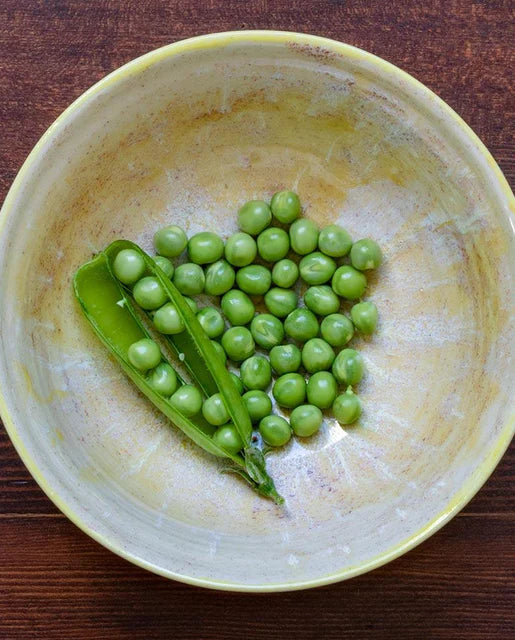
This old heirloom shelling pea dates back to 1880. It's a versatile, tasty, reliable pea that grows well in cool soil, so it's great for the north, and has good potential for spring and fall plantings. The short vines grow to only 90cm (36), but benefit from some twigs stuck in the soil for support - or a low trellis net. Once known as 'Earliest of All,' Alaska pea matures in just 55 days, making it our earliest pea of all. Expect heavy yields of round, straight, pale green pods, each containing five to eight smooth peas. For drying as soup peas, let the plants mature to 80 days.
Matures in 55 days. (Open-pollinated seeds)
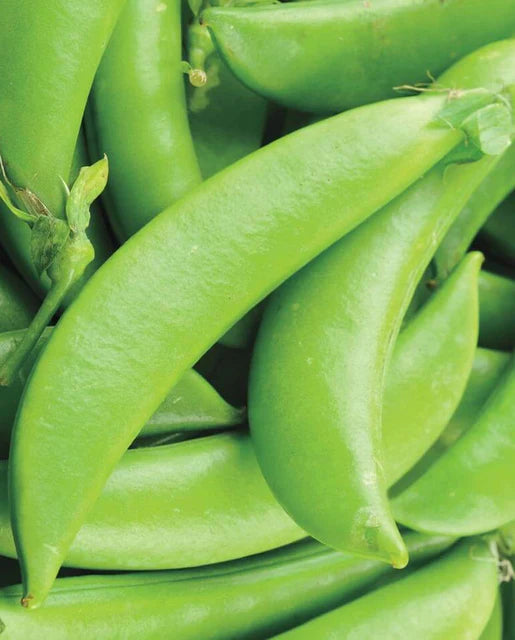
Extra early, incredibly sweet snap peas on short, 60cm (2') vines that don't require trellising. Sugar Ann snap pea seeds are an excellent choice for smaller garden spaces. The bushy plants produce crisp, tasty, 6cm (2") pods, and have excellent resistance to pea enation virus and powdery mildew. Sugar Ann was the 1984 AAS Winner, and also received the Award of Garden Merit from the Royal Horticultural Society. It has been a stand-by snap pea for West Coast Seeds for decades. If you're short on space, this is the pea for you - they can even be grown in larger containers.
Matures in 56 days. (Open-pollinated seeds)

Dwarf Grey Sugar snow pea seeds produce the earliest and most dwarf edible pods of all. The prolific, bushy vines grow to 1.5m (5') tall, and benefit from staking. Very attractive sweet pea-like flowers are followed by clusters of flat, fleshy, curved, semi-pointed pods. These are light green and average 6-8cm (2.5-3"), appearing at the tops of the plants for easy picking. This old heirloom variety was listed once as Dwarf Gray Sugar Cabbage Pea, and has been in production since before 1773. Dwarf Grey Sugar snow pea seeds were first sold commercially in 1892 by D.M Ferry and Company. This is one of the best choices for growing pea shoots and pea tips.
Matures in 66 days. (Open-pollinated seeds)

Among the largest available snow peas, these 10-13 cm (4-5") long pods are produced on 1.2m (4') tall plants that require a trellis. The large white flowers of this heirloom variety are pretty enough to use as cut flowers. Mammoth Melting Sugar snow pea seeds produce pods are sweet and tender, even sweeter and more tender than Dwarf Gray Sugar. Plants are high yielding, early, uniform, and productive. This variety is more productive in cool weather, so it's perfect for early spring planting, and a second planting in early August for fall production. Mammoth Melting Sugar is Wilt resistant.
Matures in 70 days. (Open-pollinated seeds)
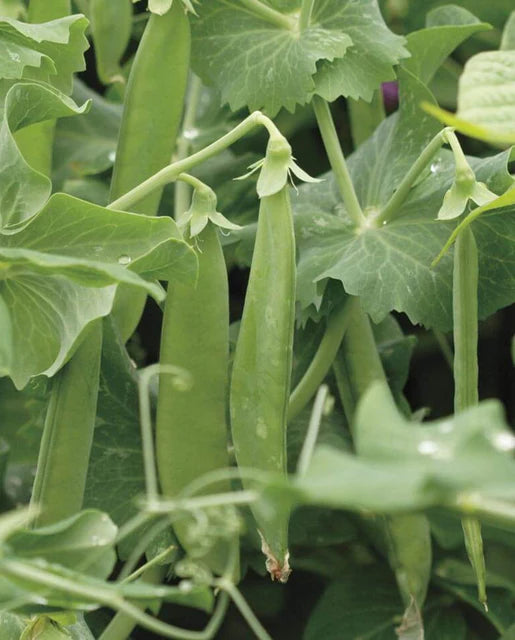
A great substitute for Mammoth Melting peas, Avalanche snow pea seeds grow into 15cm (6") pods that are sweet and tender. Plants are "semi-leafless" so they put more energy into producing pods, making for higher yields of snow peas. Plant two to three rows close together and plants will intertwine, providing support for each other. Expect a height of 90cm (36"). Avalanche is resistant to Fusarium Wilt race 1 and powdery mildew. Plant this reliable snow pea from spring to mid-summer in rich, fertile soil.
Matures in 60 days. (Open-pollinated seeds)
- Sweet and tender
- Plants are "semi-leafless"
- Resistant to fusarium wilt and mildew
- Open-pollinated seeds
- Matures in 60 days
Soaking seeds is not advised for damp soils. Sow seed 2cm (1″) deep. After April 15th, sow seed 5cm (2″) deep. Space seeds 2-7cm (1-3″) apart in the row. Do not thin. If the seeds fail to sprout, try to dig some up and check for rot or insect damage. The challenge with untreated pea seeds is to give them an early start but to avoid rot.
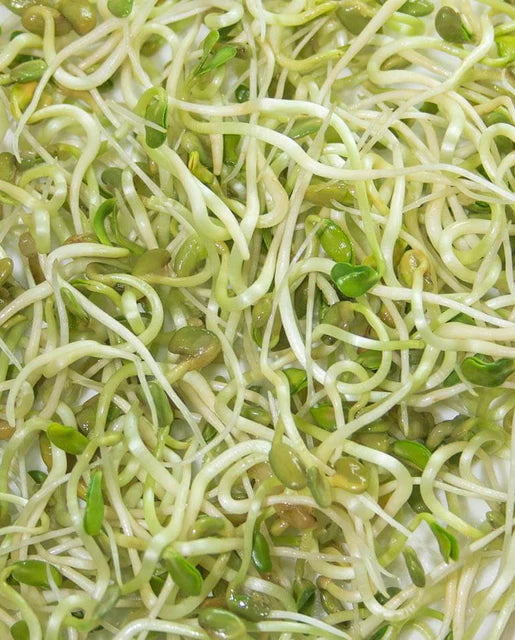
CERTIFIED ORGANIC! Fenugreek organic sprouting seeds produce large vigorous sprouts with a mild but exotic flavour. Fenugreek seeds can also be used to make a pleasant tea. Fenugreek provides a high quality protein, fibre, and wealth of vitamins including A, B1, B2, B3, B5, B6, B15, B17, C, D, E, H, folic acid, and fatty acids. Its mineral profile includes calcium, chromium, iodine, iron, magnesium, manganese, molybdenum, phosphorus, potassium, selenium, silicon, sodium, sulphur, and zinc. Fenugreek organic sprouting seeds are truly a super-food! Add to sandwiches, soups, and salads, or toss with sesame oil and enjoy them on their own.
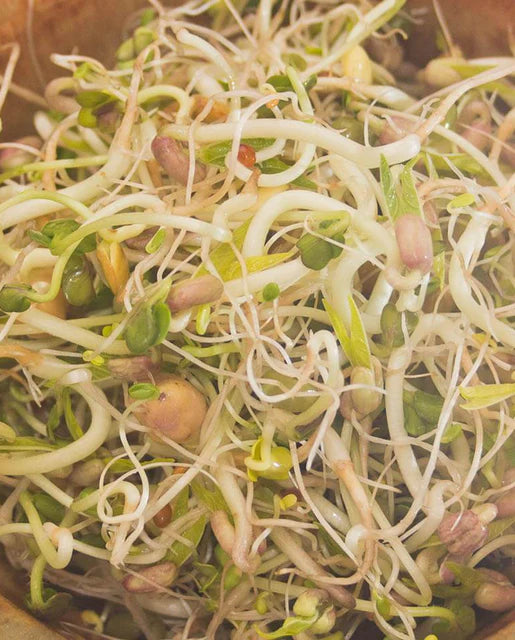
CERTIFIED ORGANIC! Mung beans, adzuki beans, chickpeas, red clover, radish, and green lentils — big, crunchy sprouts that are perfect as a salad topping, or as a salad on their own. This is the perfect mix of mild, but distinct flavours that combine for a deeply satisfying garnish or side course. This blend handles dressing beautifully. Grow Salad Blend organic sprouting seeds using the Biosta sprouter and harvest handfuls of perfect sprouts in only four to five days. This sprout blend has been a popular seller at West Coast Seeds for many years, and is much loved for its substantial sprouts and their mild flavour.
- A blend of six ingredients
- Makes really substantial sprouts
- Mild flavour
- Good cooked or raw
- Certified Organic!

$13.99
Unit price per$13.99
Unit price perCertified Organic! In the Sandwich Booster Mix organic sprouting seeds are alfalfa, mung beans, red clover, and red radish. This is the combination that some studies suggest can prevent cancer and other serious health problems. And while it’s working wonders on your health, it also tastes good as well. Superb in salad rolls. A mixture of alfalfa, mung beans, red clover, and radish sprouting seeds. This blend has an appealing, crunchy texture, with a bit of succulence from the mung beans. This mix is superb for sandwiches and salads, and enormously healthy eating. Sprouts are easier to digest than mature plants, so your body will take better advantage of the powerful nutrients within. This blend provides vitamins, minerals, protein, and dietary fibre, all in a form that is easily digested.
- Certified organic
- Alfalfa, mung, clover & radish
- Easy to digest
- Highly nutritious
- Super-food
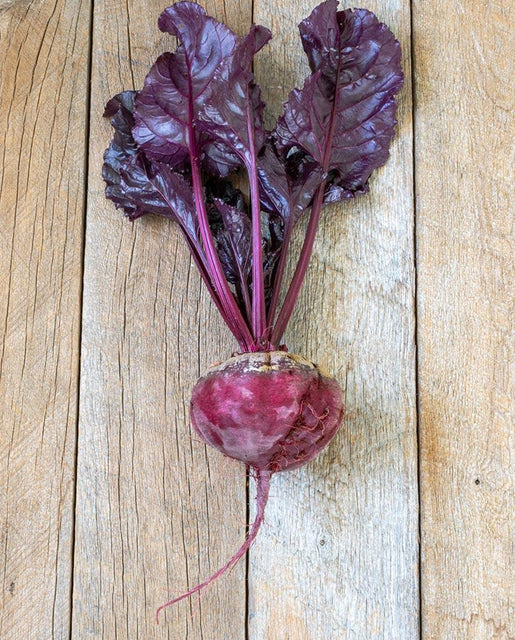
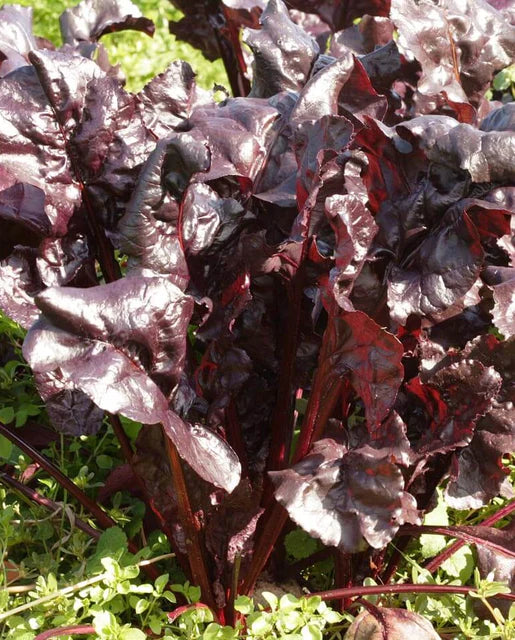
Bull's Blood beet seeds produce baby greens in 35 days, or wait 50-60 days for beetroot. This is the classic choice for salad and micro-green growers. The beautiful dark red, smooth leaves have a particularly pleasant flavour. Harvested as baby greens, they look spectacular in salad mixes. If the leaves are not harvested, the plants produce uniform, round, tasty, red beetroots. The deep red colour of both the leaves and root are thought to contain high levels of nutrients and antioxidants, which qualifies Bull's Blood organic beet seeds as a super-food.
Matures in 50-60 days. (Open-pollinated seeds)
- Produces baby greens in 30-40 days
- Can be cut repeatedly
- Unusual texture and colour in salad mixes
- Open-pollinated seeds
- Matures in 60 days
Sow 1cm (½”) deep, 5-10cm (2-4″) apart in rows 30-45cm (12-18″) apart.

Melothria scabra. Also known as the Mexican Sour Gherkin, cucamelon seeds produce vines that could be mistaken for regular cucumber plants. The plants are not quite as productive as cucumbers, but the fruits are amazingly cute and novel. They look like tiny watermelons, but have a very appealing cucumber flavour with slight citrus notes. Eat them fresh or pickle them for a crunchy treat. Harvest them at the 2cm (1") size, before the seeds develop. This is a heat loving tropical plant that is most productive in hot weather or a greenhouse setting. Start the seeds indoors and treat as you would a conventional cucumber seedling.
Matures in 67 days. (Open-pollinated seeds)
- Tiny, cute fruits
- Works well in containers
- Eat fresh or pickled
- Matures in 67 days
- Open pollinated seeds
Sow 3-4 seeds 2cm (1″) deep in each spot you want a plant to grow. Thin to the strongest seedling. Space plants 23cm (9″) apart in rows 90cm (36″) apart.

Melissa officinalis. Plant lemon balm seeds and rub the light green leaves for a sudden hit of lemon scent. Use in bouquets to lemon scent a room or brew an invigorating medicinal tea. Lemon Balm seeds produce a herbaceous perennial self-sows and bees love it. Plants grow vigorously so keep self-sown seedlings thinned out. The plants are deer resistant, so a useful filler plant for coastal areas. Chop back the plants by two thirds once the flowers have faded to prevent self sowing and to encourage the growth of new leaves. This plant belongs in every organic herb garden and has been cultivated for centuries as a medicinal plant.
- Use in a bouquets to lemon scent a room
- Brew an invigorating tea
- Self sowing and bees love it
- Deer resistant
- Plants grow vigorously
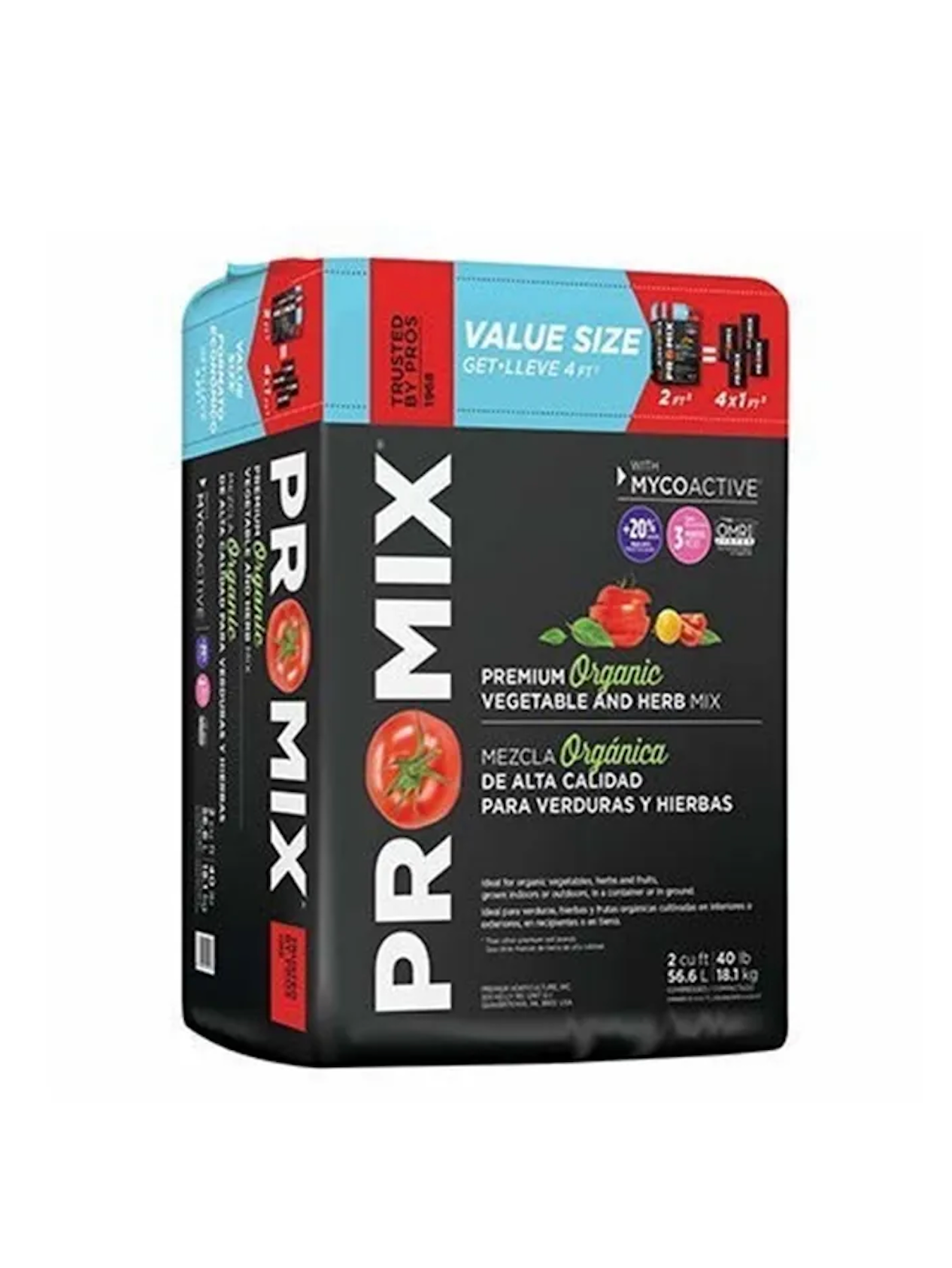

- With MYCOACTIVE technology to stimulate vigorous growth for greater stress resistance, larger root system for increased nutrients, water uptake, bigger, healthier plants
- Organic fertilizer that gradually feeds plants for up to 3 months
- OMRI Listed for use in organic gardening


**Arriving May 17th***
_________________________________________________________________________
Choose a location that is not in line with strong north winds
Plant the crown (this is where the roots end and the woody shrub begins) of your rose 6”-12” below the surface of the soil. As your shrub will be in full leaf at time of purchase you can clean off leaves that will get buried if you like.
In the fall you will need to cover with a deep layer of mulch. Wood mulch, straw, leaves or a combination of all. Use a burlap tarp (Not Plastic) to cover and hold down with rocks or stakes. This will ensure the mulch is not blown away. A full wheelbarrow or more per rose is not out of the question. Throughout the winter direct your snow clearing efforts to cover your roses as well. The more insulation the better.
Don’t remove the tarp and mulch until night temperatures are consistently hovering about zero to +3 with no threat of deep freeze, as we sometimes see in April.
We hope you enjoy growing your David Austin Rose.
David Austin Roses were not developed for Zone 3. BUT it is possible to have success here in Manitoba by following a few key tips.
Choose a location that is not in line with strong north winds
Plant the crown (this is where the roots end and the woody shrub begins) of your rose 6”-12” below the surface of the soil. As your shrub will be in full leaf at time of purchase you can clean off leaves that will get buried if you like.
In the fall you will need to cover with a deep layer of mulch. Wood mulch, straw, leaves or a combination of all. Use a burlap tarp (Not Plastic) to cover and hold down with rocks or stakes. This will ensure the mulch is not blown away. A full wheelbarrow or more per rose is not out of the question. Throughout the winter direct your snow clearing efforts to cover your roses as well. The more insulation the better.
Don’t remove the tarp and mulch until night temperatures are consistently hovering about zero to +3 with no threat of deep freeze, as we sometimes see in April.
We hope you enjoy growing your David Austin Rose.
David Austin Roses were not developed for Zone 3. BUT it is possible to have success here in Manitoba by following a few key tips.
You have three options, you can enjoy your David Austin Rose for a single season. You can plan to bring your potted David Austin Rose into a warmer winter environment, or you can plant it into the ground.
Choose a location that is not in line with strong north winds
Plant the crown (this is where the roots end and the woody shrub begins) of your rose 6”-12” below the surface of the soil. As your shrub will be in full leaf at time of purchase you can clean off leaves that will get buried if you like.
In the fall you will need to cover with a deep layer of mulch. Wood mulch, straw, leaves or a combination of all. Use a burlap tarp (Not Plastic) to cover and hold down with rocks or stakes. This will ensure the mulch is not blown away. A full wheelbarrow or more per rose is not out of the question. Throughout the winter direct your snow clearing efforts to cover your roses as well. The more insulation the better.
Don’t remove the tarp and mulch until night temperatures are consistently hovering about zero to +3 with no threat of deep freeze, as we sometimes see in April.
We hope you enjoy growing your David Austin Rose.
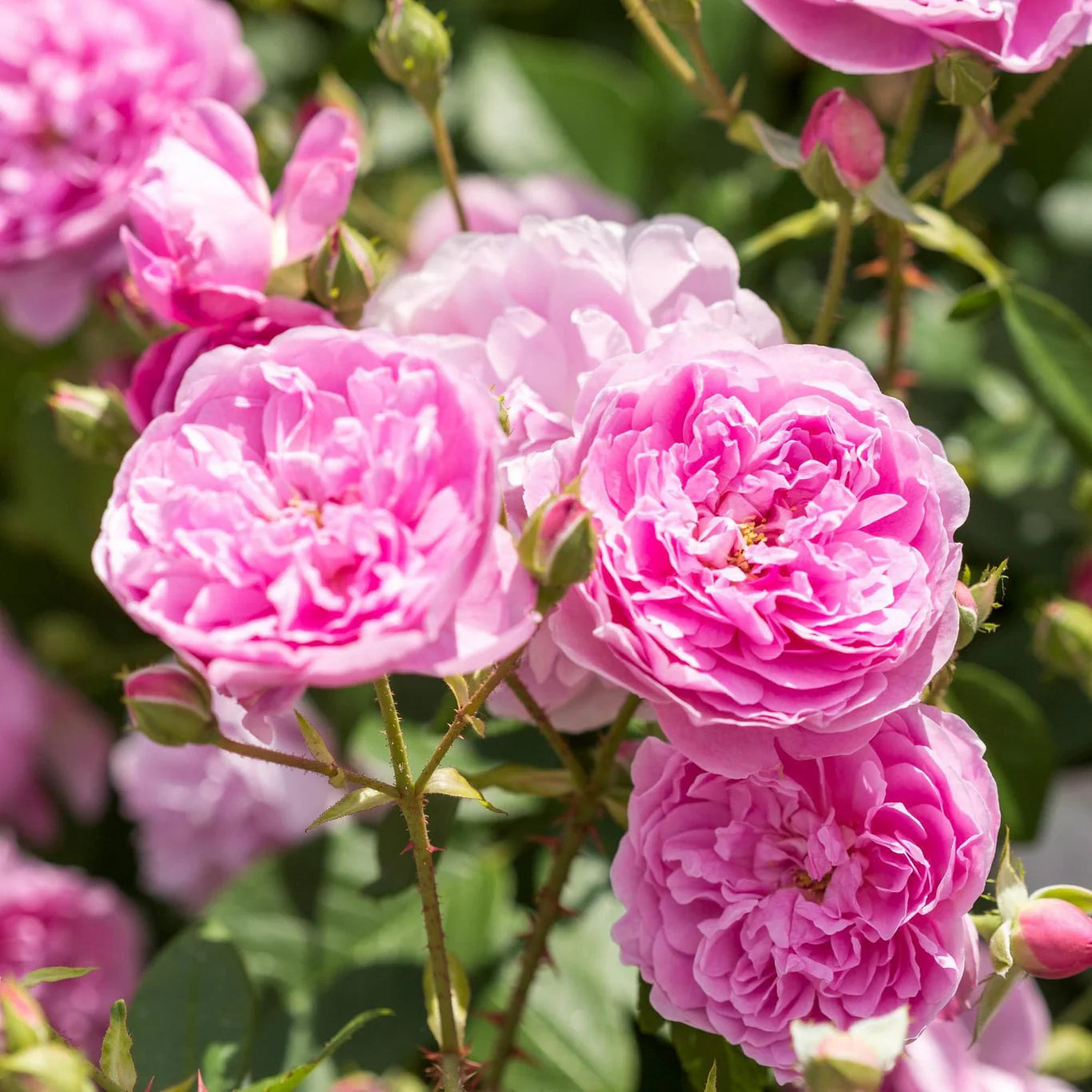
Bears flowers of the most perfect formation – shallow cups of the purest mid pink. They flower very freely from early summer until well into the autumn and have a strong, pure Old Rose fragrance. It has an excellent bushy habit with upright, vigorous growth. Maturing into an attractively rounded shrub; it flowers almost to the ground.
Named after the Royal Horticultural Society’s garden in Yorkshire, to celebrate the 200th anniversary of the society’s formation.
Zone 4
|
Bloom Size |
Medium |
|
Bloom Colour |
Mid. Pink |
|
Fragrance |
Strong Old Tea |
|
Year of Introduction |
1983 |
|
Size |
4' x 3' |
|
Family Shrub |
Root Grafted Dr. Heuy |
|
Flowering |
Repeat Bloomer |
|
Petal Count |
120 |
David Austin Roses were not developed for Zone 3. BUT ,it is possible to have success here in Manitoba by following a few key tips.
Choose a location that is not in line with strong north winds
Plant the crown (this is where the roots end and the woody shrub begins) of your rose 6”-12” below the surface of the soil. As your shrub will be in full leaf at time of purchase you can clean off leaves that will get buried if you like.
In the fall you will need to cover with a deep layer of mulch. Wood mulch, straw, leaves or a combination of all. Use a burlap tarp (Not Plastic) to cover and hold down with rocks or stakes. This will ensure the mulch is not blown away. A full wheelbarrow or more per rose is not out of the question. Throughout the winter direct your snow clearing efforts to cover your roses as well. The more insulation the better.
Don’t remove the tarp and mulch until night temperatures are consistently hovering about zero to +3 with no threat of deep freeze, as we sometimes see in April.
We hope you enjoy growing your
David Austin Rose.


The perfectly formed, shallow cups are pure light pink, paling to soft blush on the outer petals. There is a strong, warm myrrh fragrance. It forms an attractive, quite broad shrub, with slightly arching stems. The leaves are tinged red at first, later turning green. Hermione is the faithful wife of Leontes, the King of Sicila, in Shakespeare’s The Winter’s Tale.
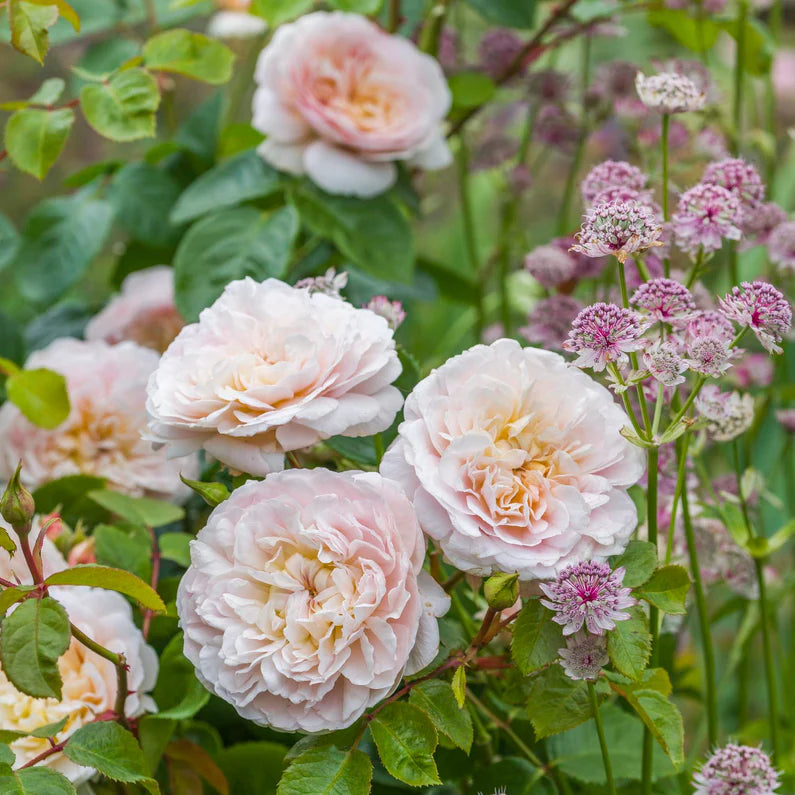
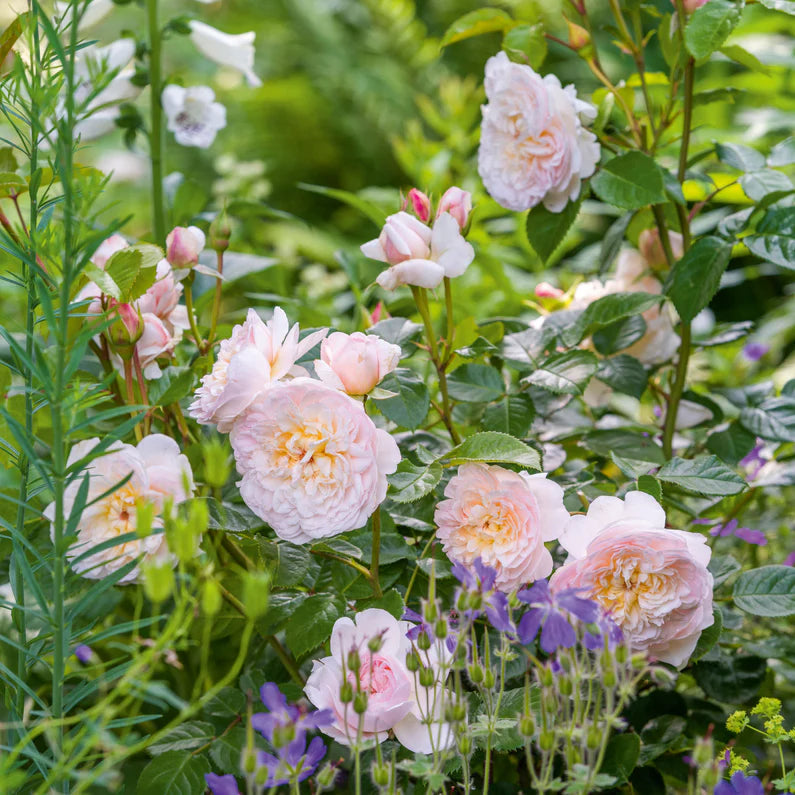
An exceptionally beautiful rose with distinctive neat, flat blooms. Each bloom is a lovely soft pink, the smaller central petals deepening to rich apricot and surrounding deep-set stamens. The strong Tea scent becomes more Old Rose, with delicious hints of lemon and grapefruit. It forms a bushy shrub with strong, healthy, upright growth. Named for the Brontë Society to celebrate the bicentenary of the novelist’s birth.
David Austin Roses were not developed for Zone 3. BUT it is possible to have success here in Manitoba by following a few key tips.
Choose a location that is not in line with strong north winds
Plant the crown (this is where the roots end and the woody shrub begins) of your rose 6”-12” below the surface of the soil. As your shrub will be in full leaf at time of purchase clean off leaves that will get buried.
In the fall you will need to cover with a deep layer of mulch. Wood mulch, straw, leaves or a combination of all. Use a burlap tarp (Not Plastic) to cover and hold down with rocks or stakes. This will ensure the mulch is not blown away. A full wheelbarrow or more per rose is not out of the question. Throughout the winter direct your snow clearing efforts to cover your roses as well. The more insulation the better.
Don’t remove the tarp and mulch until night temperatures are consistently hovering about zero to +3 with no threat of deep freeze, as we sometimes see in April.
We hope you enjoy growing your David Austin Rose.
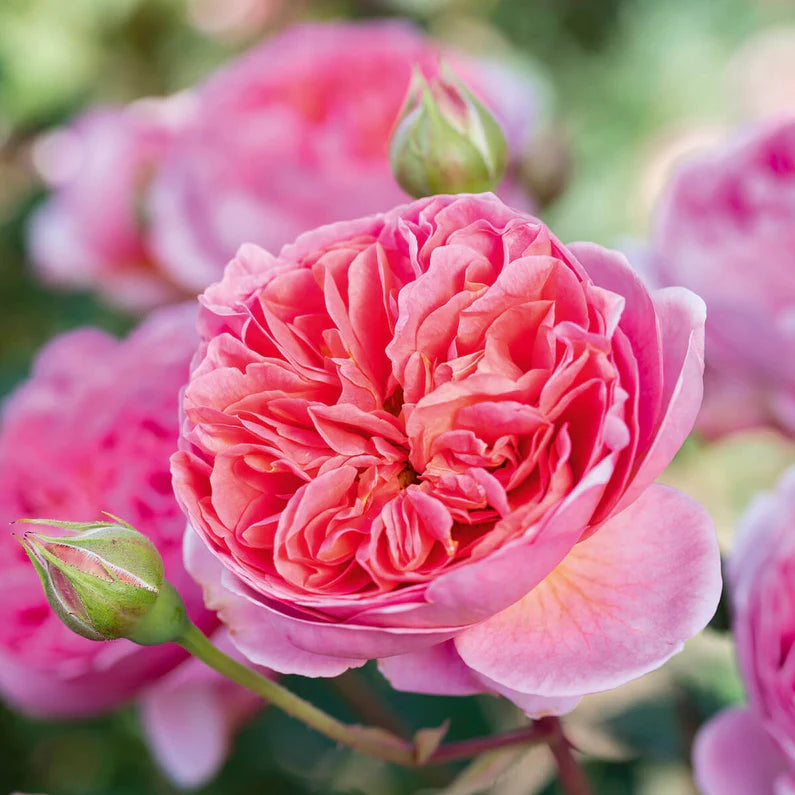
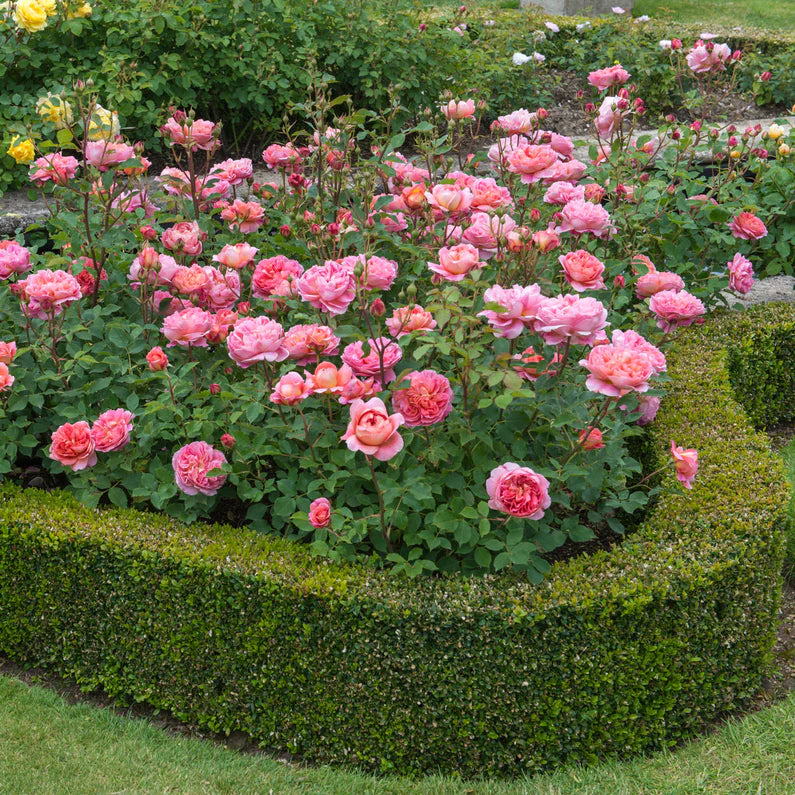
Red buds open to beautifully formed, upward facing, coral-pink rosettes. Small petals of varying shades mingle to provide a most pleasing effect. The myrrh fragrance has delicious hints of hawthorn, elder flower, pear and almond. It forms an upright shrub. Charles II hid in an oak tree at Boscobel House during the English Civil War.
David Austin Roses were not developed for Zone 3. BUT it is possible to have success here in Manitoba by following a few key tips.
_________________________________________________________________________
You have three options, you can enjoy your David Austin Rose for a single season. You can plan to bring your potted David Austin Rose into a warmer winter environment, or you can plant it into the ground.
If you decide to enjoy your rose for the summer:
Feel free to drop your potted David Austin Rose into a decor pot of your liking, but do not pot it up into a larger size planter. You do not want to set back your rose. We use our Rose and Perennial Mix when potting up all our David Austin Roses and other than fertilizing your rose every other week they are simple to care for. In our experience you should have blooms from late June right through till fall.
If you decide to grow and over winter your rose in a pot:
First, you must be sure you have a place to overwinter your David Austin Rose and you should pot up your rose into a planter large enough for min of 2 years growth, using our rose and perennial mix.
Do not use pro mix.
A heated garage or sunroom that can be set between -2C and -5C. You will also need to keep your rose away from doors that open to -35C or colder. Your Rose needs to go dormant for a few months. Once the temp is over zero C you will see your rose begin to send out new shoots. At this point natural light is necessary and the temperature should not go below -1C at night. It is important to keep your shrub moist but not wet. Check temperature regularly. Do not bring it into the house! Roses can handle cool nights and warmer days.
If you decide to plant your rose in the ground:
Choose a location that is not in line with strong north winds
Plant the crown (this is where the roots end and the woody shrub begins) of your rose 6”-12” below the surface of the soil. As your shrub will be in full leaf at time of purchase you can clean off leaves that will get buried if you like.
In the fall you will need to cover with a deep layer of mulch. Wood mulch, straw, leaves or a combination of all. Use a burlap tarp (Not Plastic) to cover and hold down with rocks or stakes. This will ensure the mulch is not blown away. A full wheelbarrow or more per rose is not out of the question. Throughout the winter direct your snow clearing efforts to cover your roses as well. The more insulation the better.
Don’t remove the tarp and mulch until night temperatures are consistently hovering about zero to +3 with no threat of deep freeze, as we sometimes see in April.
We hope you enjoy growing your David Austin Rose.

|
Bloom Size |
Medium |
|
Bloom Colour |
Creamy White |
|
Fragrance |
Strong Myrrh |
|
Year of Introduction |
2007 |
|
Size |
3m |
|
Family Climbing |
Root Own |
|
Flowering |
Repeat Bloomer |
|
Petal Count |
David Austin Roses were not developed for Zone 3. BUT it is possible to have success here in Manitoba by following a few key tips.
Choose a location that is not in line with strong north winds
Plant the crown (this is where the roots end and the woody shrub begins) of your rose 6”-12” below the surface of the soil. As your shrub will be in full leaf at time of purchase you can clean off leaves that will get buried if you like.
In the fall you will need to cover with a deep layer of mulch. Wood mulch, straw, leaves or a combination of all. Use a burlap tarp (Not Plastic) to cover and hold down with rocks or stakes. This will ensure the mulch is not blown away. A full wheelbarrow or more per rose is not out of the question. Throughout the winter direct your snow clearing efforts to cover your roses as well. The more insulation the better.
Don’t remove the tarp and mulch until night temperatures are consistently hovering about zero to +3 with no threat of deep freeze, as we sometimes see in April.
We hope you enjoy growing yourDavid Austin Rose.
***Arriving May 17th***
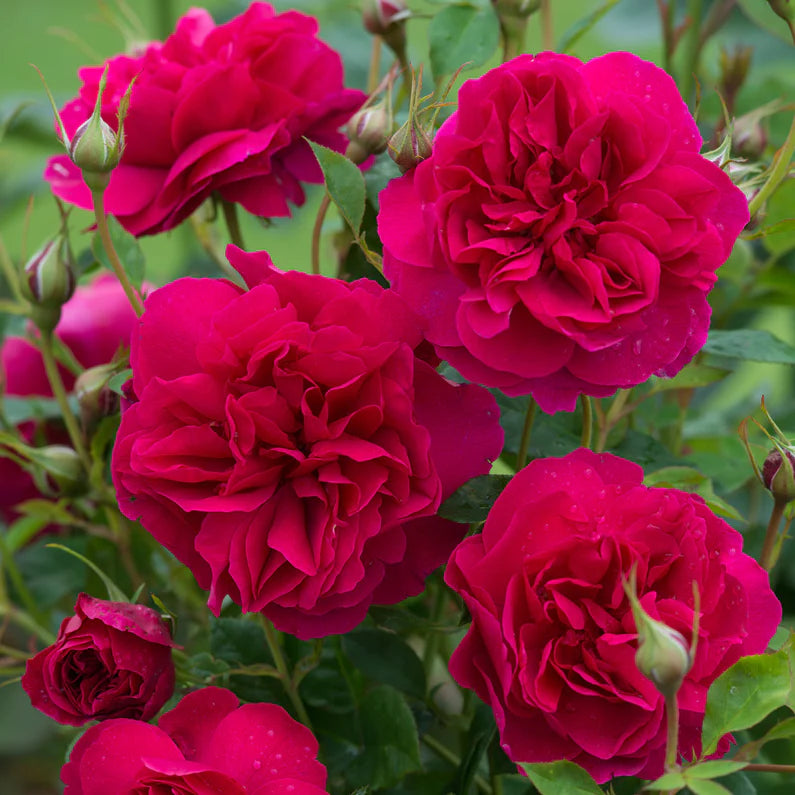
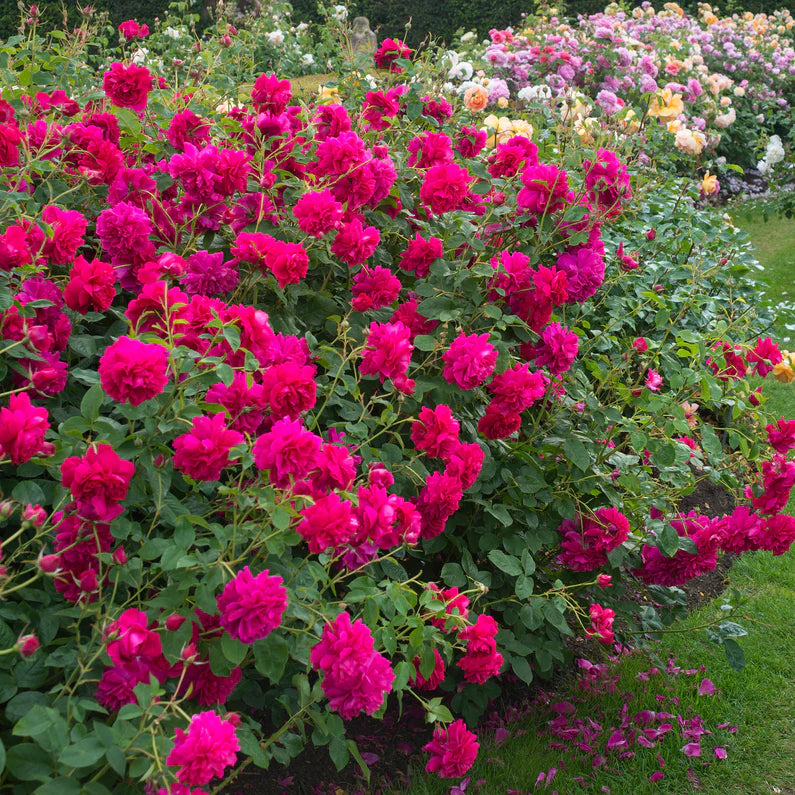
This is a variety of very different character from the general run of English Roses, being rather closer to the Species Roses than to the Old Roses and more natural and shrubby in growth. A striking crimson-red; the individual flowers can best be described as shallowly cupped, opening as informal rosettes; the petals quickly reflexing as the flowers age. They are held in medium-sized heads; the individual blooms nodding attractively on the stem. They have an Old Rose fragrance with a strong lemon zest character. It forms a strong, rather informal shrub. Named for Canterbury Cathedral.
David Austin Roses were not developed for Zone 3. BUT it is possible to have success here in Manitoba by following a few key tips.
Choose a location that is not in line with strong north winds
Plant the crown (this is where the roots end and the woody shrub begins) of your rose 6”-12” below the surface of the soil. As your shrub will be in full leaf at time of purchase you can clean off leaves that will get buried if you like.
In the fall you will need to cover with a deep layer of mulch. Wood mulch, straw, leaves or a combination of all. Use a burlap tarp (Not Plastic) to cover and hold down with rocks or stakes. This will ensure the mulch is not blown away. A full wheelbarrow or more per rose is not out of the question. Throughout the winter direct your snow clearing efforts to cover your roses as well. The more insulation the better.
Don’t remove the tarp and mulch until night temperatures are consistently hovering about zero to +3 with no threat of deep freeze, as we sometimes see in April.
We hope you enjoy growing your David Austin Rose.
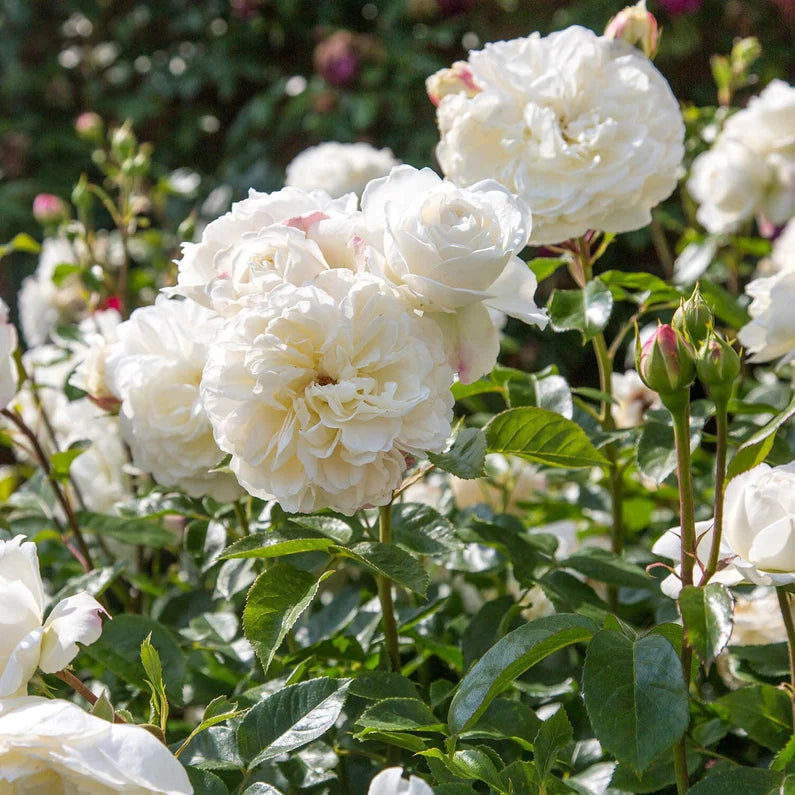
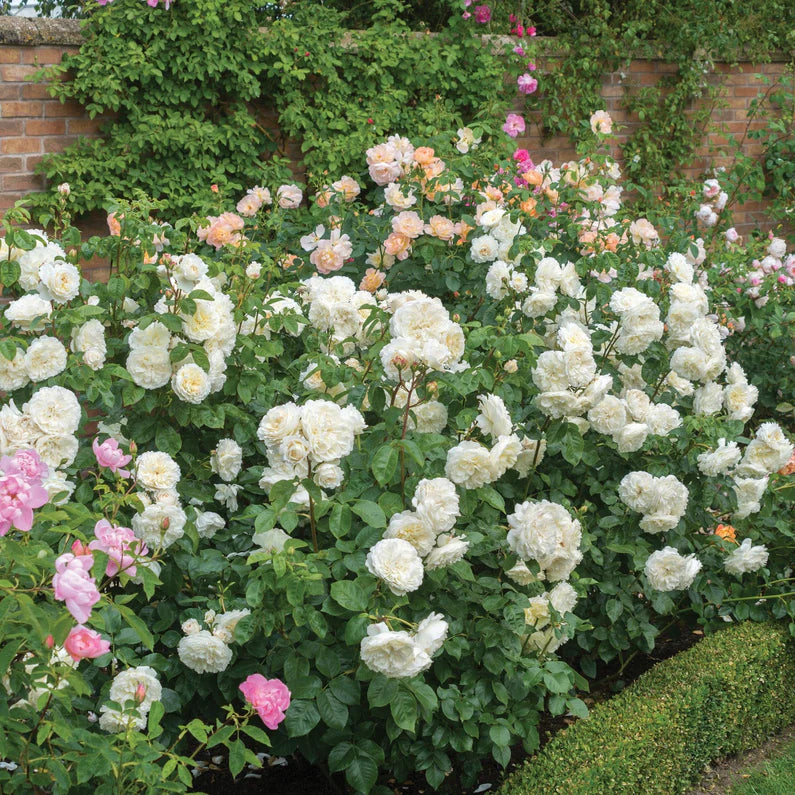
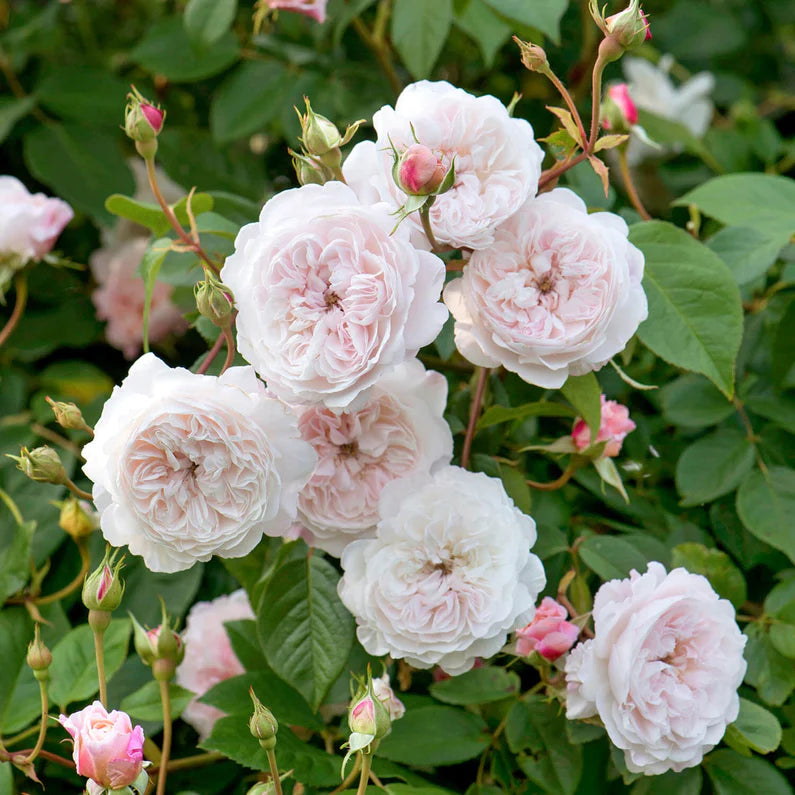
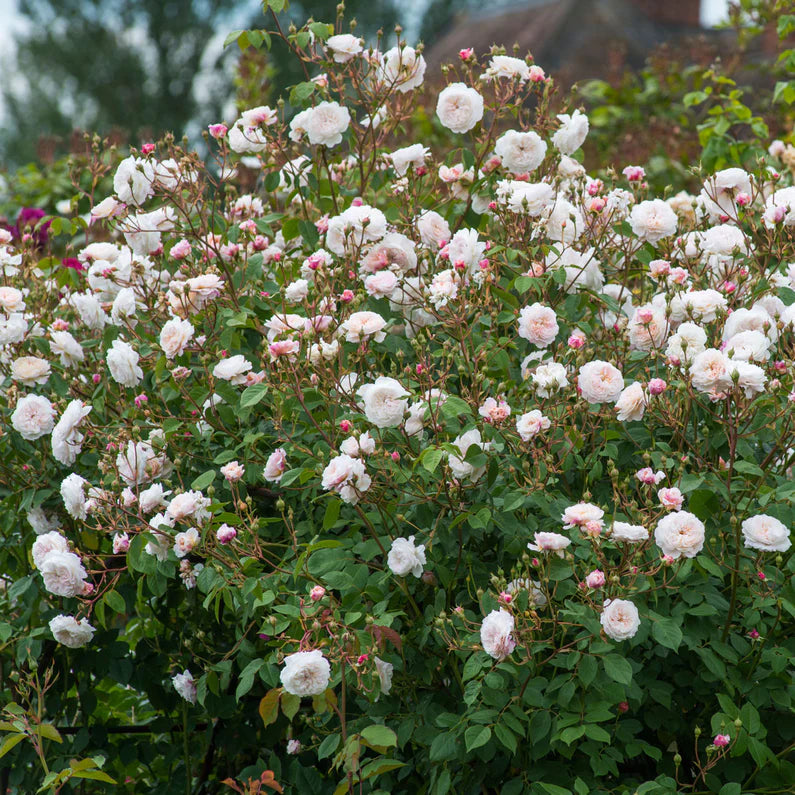
Beautifully rounded flowers, with neatly placed petals making up perfect rosettes. The buds are lightly tinged with yellow but as the flowers open they become pure white. A vigorous shrub; its growth is bushy and upright, clothed in light green foliage, curving outwards in a most attractive manner. With its pure white flowers, this rose lives up to its name.


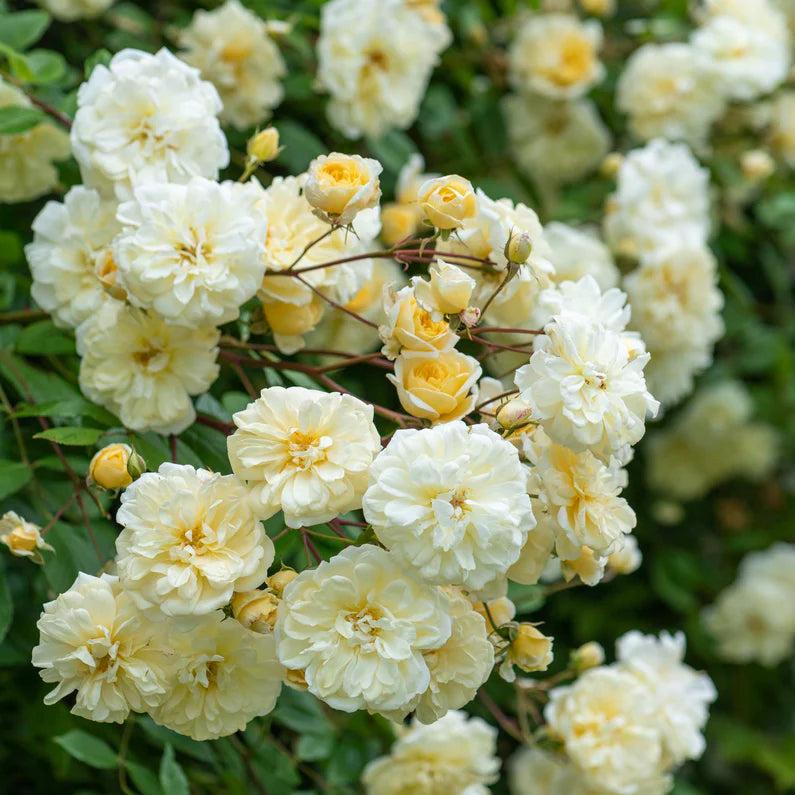
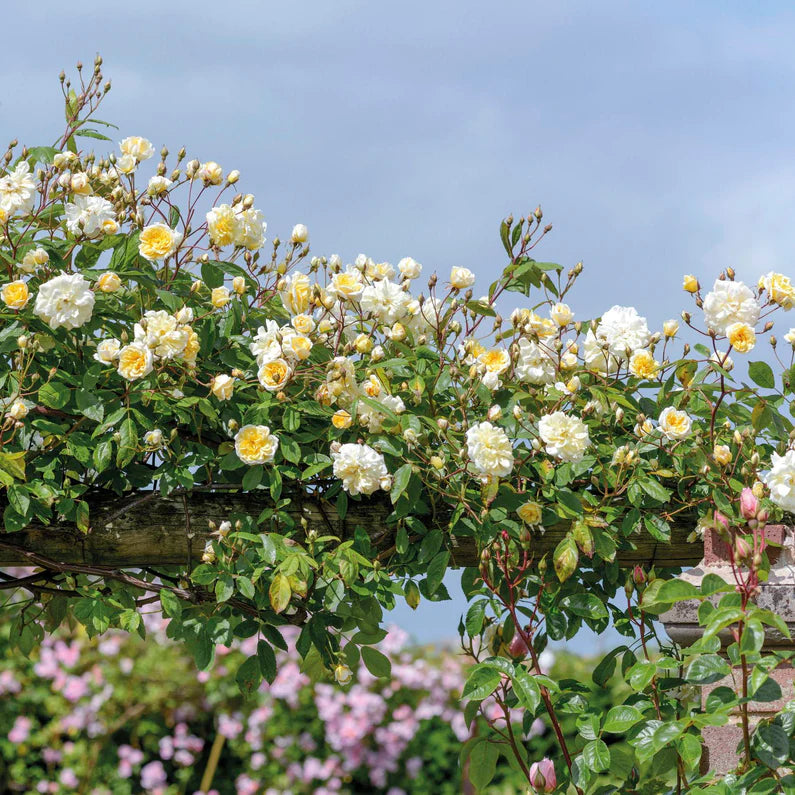
A wonderfully fragrant climber – its strong, warm myrrh fragrance has intense hints of citrus. The buds have attractive flashes of red, open to beautifully rounded, chalice-shaped blooms of pale apricot, eventually paling to cream. Named for one of the most beautiful private gardens in the country.
David Austin Roses were not developed for Zone 3. BUT it is possible to have success here in Manitoba by following a few key tips.
Choose a location that is not in line with strong north winds
Plant the crown (this is where the roots end and the woody shrub begins) of your rose 6”-12” below the surface of the soil. As your shrub will be in full leaf at time of purchase you can clean off leaves that will get buried if you like.
In the fall you will need to cover with a deep layer of mulch. Wood mulch, straw, leaves or a combination of all. Use a burlap tarp (Not Plastic) to cover and hold down with rocks or stakes. This will ensure the mulch is not blown away. A full wheelbarrow or more per rose is not out of the question. Throughout the winter direct your snow clearing efforts to cover your roses as well. The more insulation the better.
Don’t remove the tarp and mulch until night temperatures are consistently hovering about zero to +3 with no threat of deep freeze, as we sometimes see in April.
We hope you enjoy growing your David Austin Rose.


Pink-tinged buds open to medium-sized cups held in large clusters. Pale yellow, paling to white at the edges; each has a rich yellow eye. The fragrance is similar to green tea with aspects of lemon and honey. It forms a bushy, upright shrub. Named for the artist, designer and founder member of the Bloomsbury Group – sister of the writer, Virginia Woolf.


One of the largest-flowered English Roses, bearing rich yellow blooms in the form of giant cups. They have a strong Tea fragrance, developing wonderfully combined notes of Sauternes wine and strawberry. It forms a rounded shrub, with ample foliage – the flowers held beautifully poised on long, arching branches.


Bears medium-sized neat rosette blooms – tinged with orange at first, quickly becoming rich yellow. It has a light-medium musky Tea Rose scent. The growth is compact, even and upright. Named after Wolverhampton Wanderers’ football stadium.
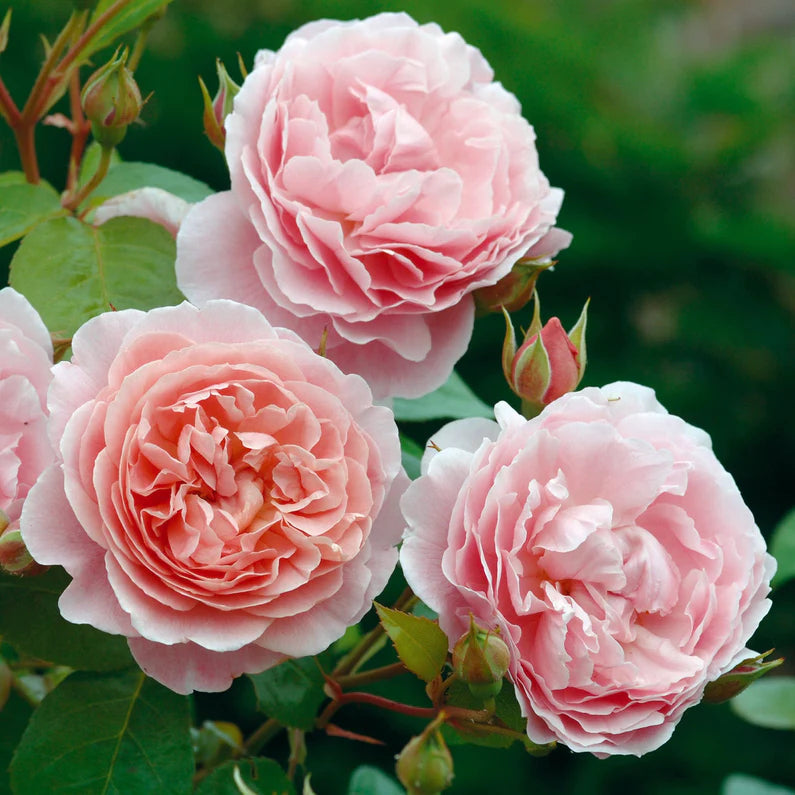
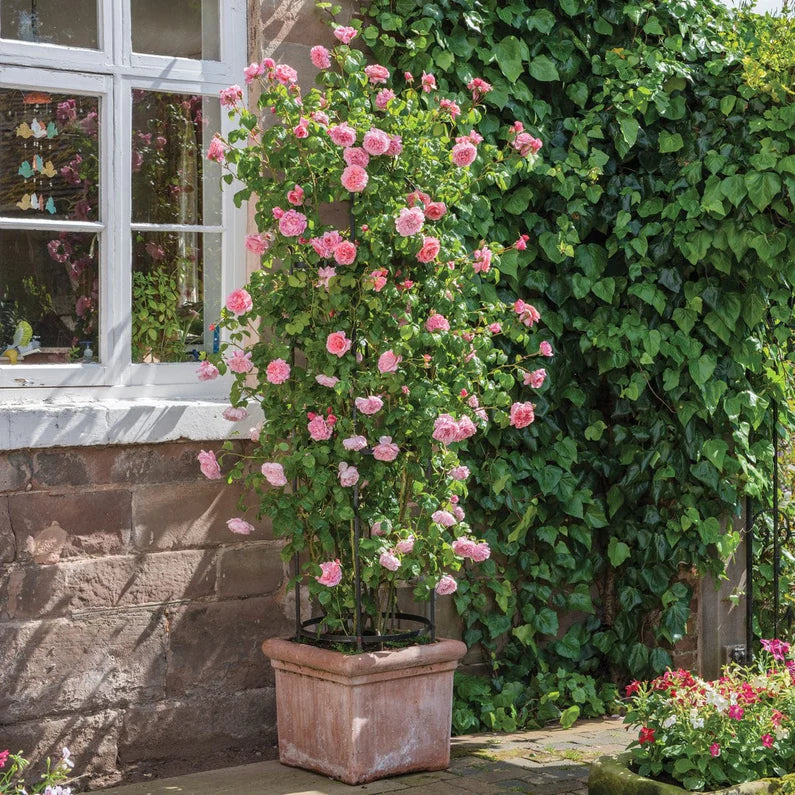
Beautiful at all stages, bearing small clusters of mid pink, medium-large, cupped rosettes. They have a strong, delicious myrrh and heather honey fragrance. The arching branches are clothed in glossy, dark foliage. Named after the gothic revival house in Twickenham, London, built by Horace Walpole.