
David Austin Roses
Out of Province? No problem, we can ship David Austin Roses across Canada! Contact us at info@vdmgarden.ca to place an order!
18 products
18 products
Sort by:
David Austin Roses


A magnificent variety, bearing medium sized, many petalled rosette blooms. They are a striking shade of deep pink, the outer petals of each bloom paling slightly over time. The beauty of the blooms is enhanced by a wonderful, strong fruity fragrance. A vigorous rose; it forms a very shapely, broad, rounded shrub with mulberry purple stems and dark green foliage, giving the overall impression of richness and abundance. Named after the beloved character in Thomas Hardy’s novel, Far from the Madding Crowd.
David Austin Roses were not developed for Zone 3. BUT it is possible to have success here in Manitoba by following a few key tips.
Choose a location that is not in line with strong north winds
Plant the crown (this is where the roots end and the woody shrub begins) of your rose 6”-12” below the surface of the soil. As your shrub will be in full leaf at time of purchase you can clean off leaves that will get buried if you like.
In the fall you will need to cover with a deep layer of mulch. Wood mulch, straw, leaves or a combination of all. Use a burlap tarp (Not Plastic) to cover and hold down with rocks or stakes. This will ensure the mulch is not blown away. A full wheelbarrow or more per rose is not out of the question. Throughout the winter direct your snow clearing efforts to cover your roses as well. The more insulation the better.
Don’t remove the tarp and mulch until night temperatures are consistently hovering about zero to +3 with no threat of deep freeze, as we sometimes see in April.
We hope you enjoy growing your David Austin Rose.
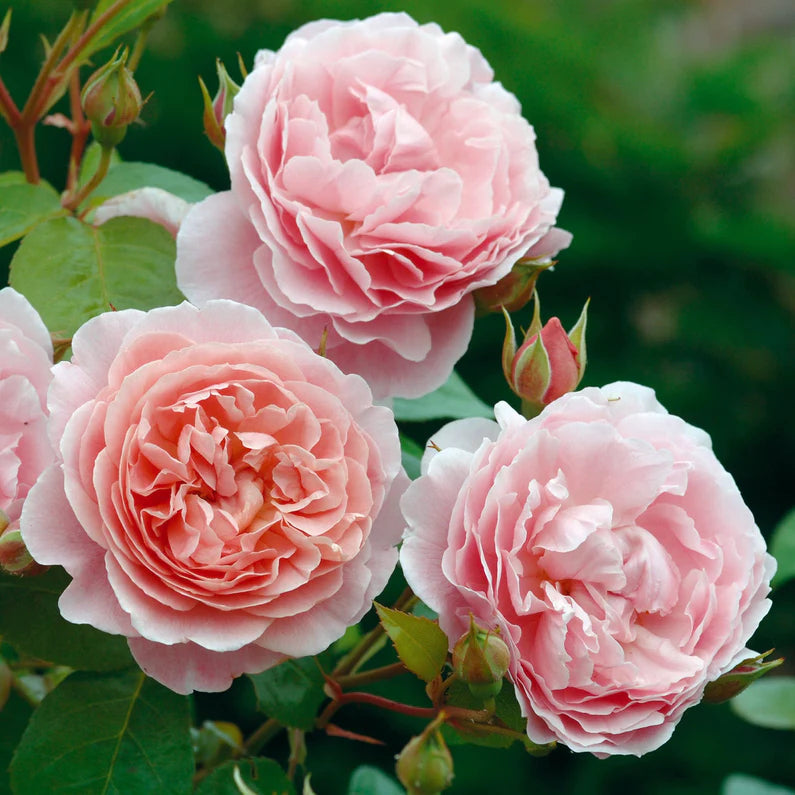
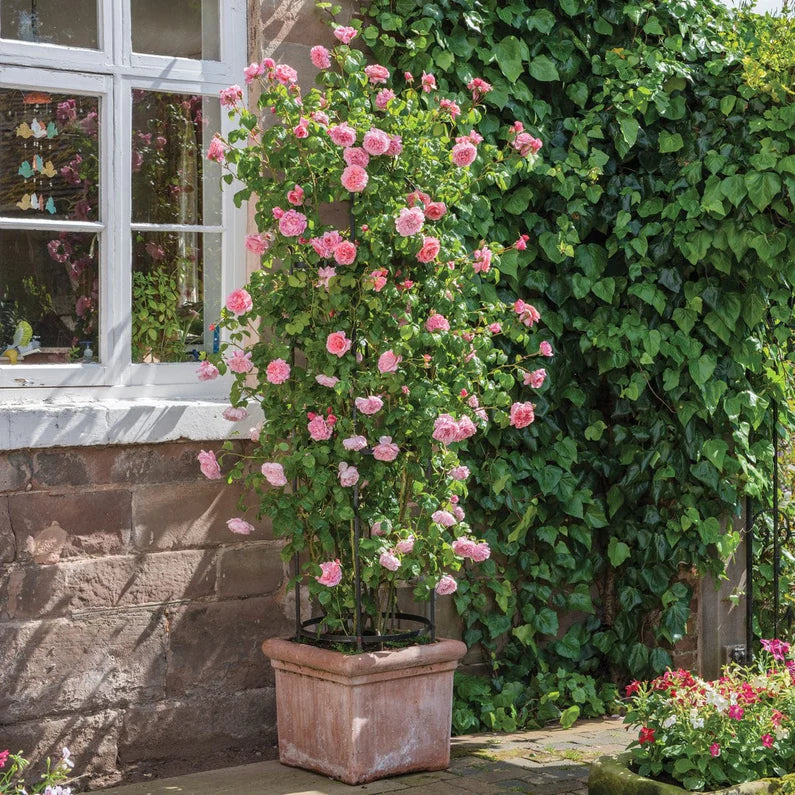
Beautiful at all stages, bearing small clusters of mid pink, medium-large, cupped rosettes. They have a strong, delicious myrrh and heather honey fragrance. The arching branches are clothed in glossy, dark foliage. Named after the gothic revival house in Twickenham, London, built by Horace Walpole.


Bears large, quartered rosettes, each about 4” across, packed with loosely arranged petals. They are a beautiful shade of pure apricot, paling towards the edges. There is a lovely Tea fragrance, with hints of cedar wood and vanilla. Named for Plant Heritage, who do so much to protect Britain’s garden plant diversity.


One of the largest-flowered English Roses, bearing rich yellow blooms in the form of giant cups. They have a strong Tea fragrance, developing wonderfully combined notes of Sauternes wine and strawberry. It forms a rounded shrub, with ample foliage – the flowers held beautifully poised on long, arching branches.


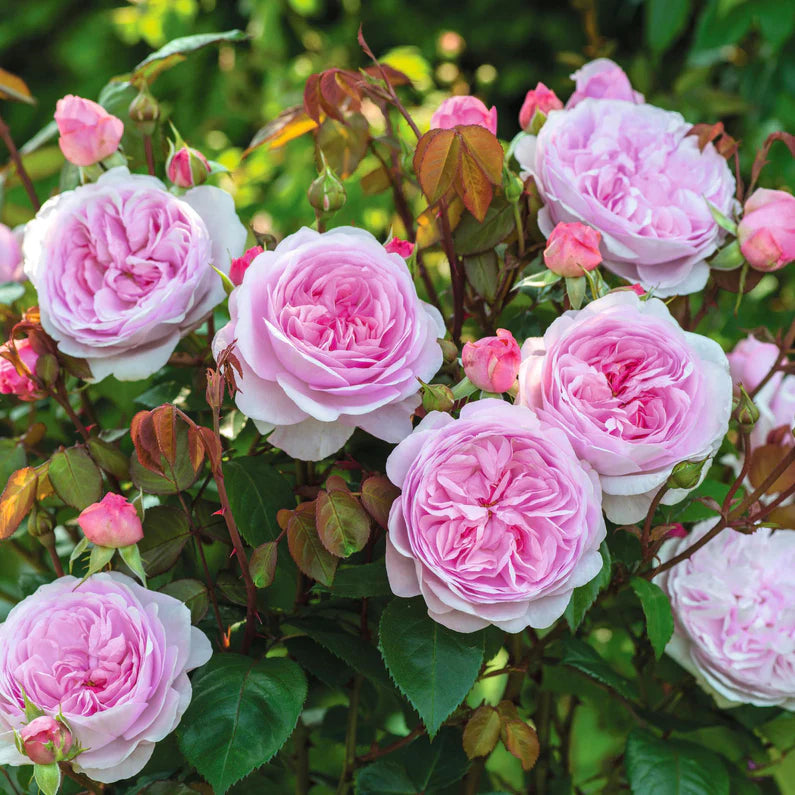
The perfectly formed, shallow cups are pure light pink, paling to soft blush on the outer petals. There is a strong, warm myrrh fragrance. It forms an attractive, quite broad shrub, with slightly arching stems. The leaves are tinged red at first, later turning green. Hermione is the faithful wife of Leontes, the King of Sicila, in Shakespeare’s The Winter’s Tale.
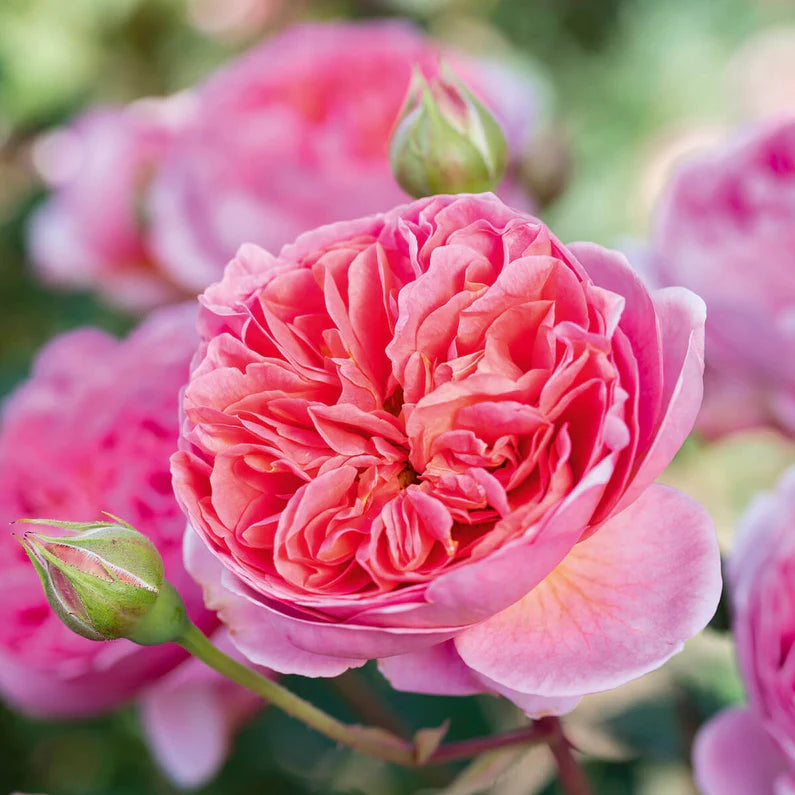
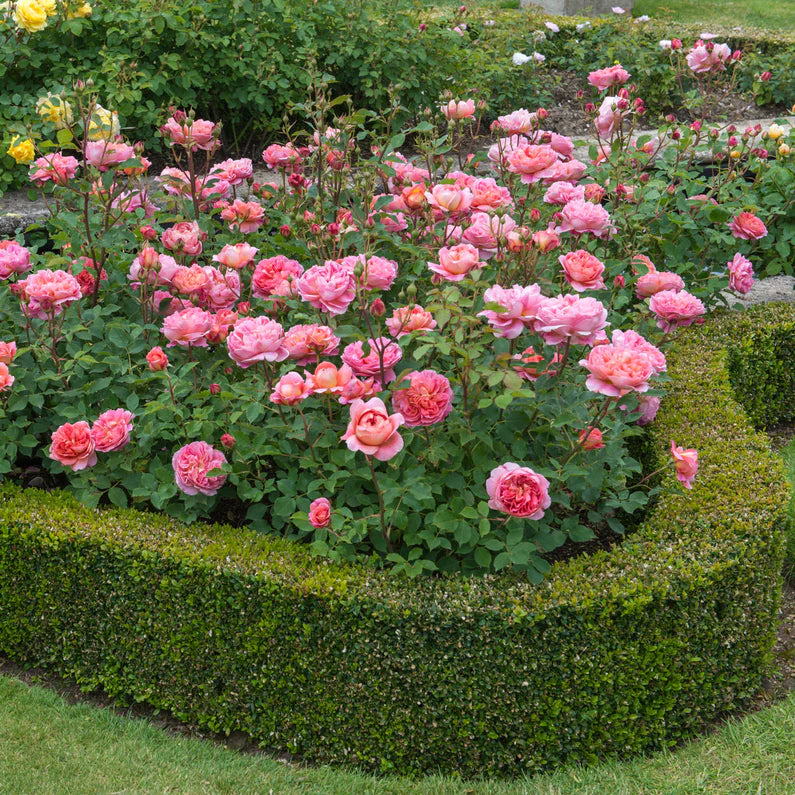
Red buds open to beautifully formed, upward facing, coral-pink rosettes. Small petals of varying shades mingle to provide a most pleasing effect. The myrrh fragrance has delicious hints of hawthorn, elder flower, pear and almond. It forms an upright shrub. Charles II hid in an oak tree at Boscobel House during the English Civil War.
David Austin Roses were not developed for Zone 3. BUT it is possible to have success here in Manitoba by following a few key tips.
_________________________________________________________________________
You have three options, you can enjoy your David Austin Rose for a single season. You can plan to bring your potted David Austin Rose into a warmer winter environment, or you can plant it into the ground.
If you decide to enjoy your rose for the summer:
Feel free to drop your potted David Austin Rose into a decor pot of your liking, but do not pot it up into a larger size planter. You do not want to set back your rose. We use our Rose and Perennial Mix when potting up all our David Austin Roses and other than fertilizing your rose every other week they are simple to care for. In our experience you should have blooms from late June right through till fall.
If you decide to grow and over winter your rose in a pot:
First, you must be sure you have a place to overwinter your David Austin Rose and you should pot up your rose into a planter large enough for min of 2 years growth, using our rose and perennial mix.
Do not use pro mix.
A heated garage or sunroom that can be set between -2C and -5C. You will also need to keep your rose away from doors that open to -35C or colder. Your Rose needs to go dormant for a few months. Once the temp is over zero C you will see your rose begin to send out new shoots. At this point natural light is necessary and the temperature should not go below -1C at night. It is important to keep your shrub moist but not wet. Check temperature regularly. Do not bring it into the house! Roses can handle cool nights and warmer days.
If you decide to plant your rose in the ground:
Choose a location that is not in line with strong north winds
Plant the crown (this is where the roots end and the woody shrub begins) of your rose 6”-12” below the surface of the soil. As your shrub will be in full leaf at time of purchase you can clean off leaves that will get buried if you like.
In the fall you will need to cover with a deep layer of mulch. Wood mulch, straw, leaves or a combination of all. Use a burlap tarp (Not Plastic) to cover and hold down with rocks or stakes. This will ensure the mulch is not blown away. A full wheelbarrow or more per rose is not out of the question. Throughout the winter direct your snow clearing efforts to cover your roses as well. The more insulation the better.
Don’t remove the tarp and mulch until night temperatures are consistently hovering about zero to +3 with no threat of deep freeze, as we sometimes see in April.
We hope you enjoy growing your David Austin Rose.


A wonderfully fragrant climber – its strong, warm myrrh fragrance has intense hints of citrus. The buds have attractive flashes of red, open to beautifully rounded, chalice-shaped blooms of pale apricot, eventually paling to cream. Named for one of the most beautiful private gardens in the country.
David Austin Roses were not developed for Zone 3. BUT it is possible to have success here in Manitoba by following a few key tips.
Choose a location that is not in line with strong north winds
Plant the crown (this is where the roots end and the woody shrub begins) of your rose 6”-12” below the surface of the soil. As your shrub will be in full leaf at time of purchase you can clean off leaves that will get buried if you like.
In the fall you will need to cover with a deep layer of mulch. Wood mulch, straw, leaves or a combination of all. Use a burlap tarp (Not Plastic) to cover and hold down with rocks or stakes. This will ensure the mulch is not blown away. A full wheelbarrow or more per rose is not out of the question. Throughout the winter direct your snow clearing efforts to cover your roses as well. The more insulation the better.
Don’t remove the tarp and mulch until night temperatures are consistently hovering about zero to +3 with no threat of deep freeze, as we sometimes see in April.
We hope you enjoy growing your David Austin Rose.
David Austin Roses were not developed for Zone 3. BUT it is possible to have success here in Manitoba by following a few key tips.
_________________________________________________________________________
You have three options, you can enjoy your David Austin Rose for a single season. You can plan to bring your potted David Austin Rose into a warmer winter environment, or you can plant it into the ground.
If you decide to enjoy your rose for the summer:
Feel free to drop your potted David Austin Rose into a decor pot of your liking, but do not pot it up into a larger size planter. You do not want to set back your rose. We use our Rose and Perennial Mix when potting up all our David Austin Roses and other than fertilizing your rose every other week they are simple to care for. In our experience you should have blooms from late June right through till fall.
If you decide to grow and over winter your rose in a pot:
First, you must be sure you have a place to overwinter your David Austin Rose and you should pot up your rose into a planter large enough for min of 2 years growth, using our rose and perennial mix.
Do not use pro mix.
A heated garage or sunroom that can be set between -2C and -5C. You will also need to keep your rose away from doors that open to -35C or colder. Your Rose needs to go dormant for a few months. Once the temp is over zero C you will see your rose begin to send out new shoots. At this point natural light is necessary and the temperature should not go below -1C at night. It is important to keep your shrub moist but not wet. Check temperature regularly. Do not bring it into the house! Roses can handle cool nights and warmer days.
If you decide to plant your rose in the ground:
Choose a location that is not in line with strong north winds
Plant the crown (this is where the roots end and the woody shrub begins) of your rose 6”-12” below the surface of the soil. As your shrub will be in full leaf at time of purchase you can clean off leaves that will get buried if you like.
In the fall you will need to cover with a deep layer of mulch. Wood mulch, straw, leaves or a combination of all. Use a burlap tarp (Not Plastic) to cover and hold down with rocks or stakes. This will ensure the mulch is not blown away. A full wheelbarrow or more per rose is not out of the question. Throughout the winter direct your snow clearing efforts to cover your roses as well. The more insulation the better.
Don’t remove the tarp and mulch until night temperatures are consistently hovering about zero to +3 with no threat of deep freeze, as we sometimes see in April.
We hope you enjoy growing your David Austin Rose.


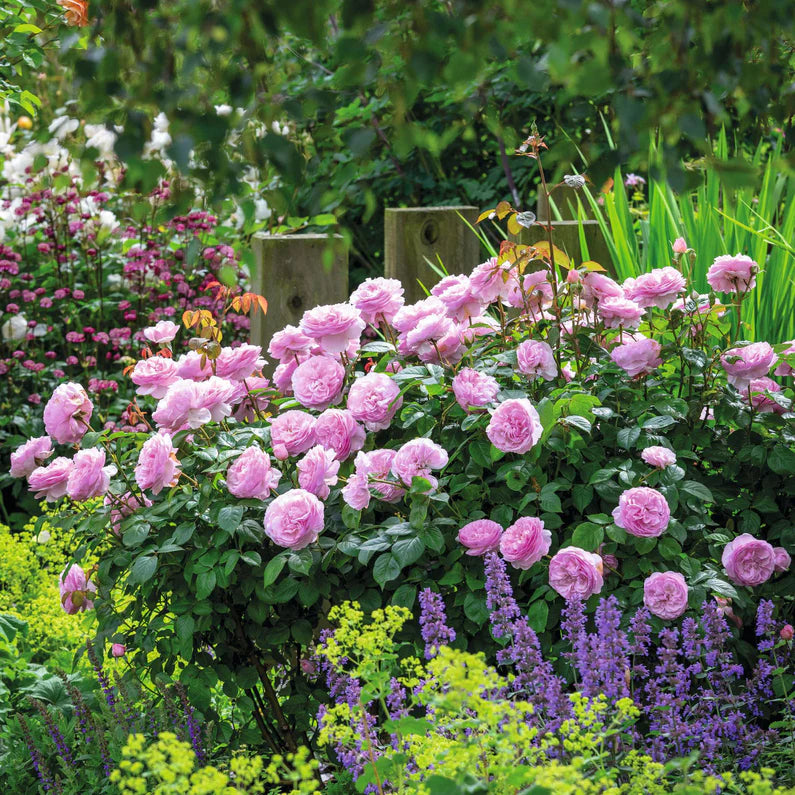
With its vigorous, upright growth it makes a wonderful climber in a short time. The strikingly beautiful flowers are mid pink at the centre, gradually becoming lighter towards the edges. The numerous, neatly placed petals in each bloom create a slightly domed shape. Named after the Irish flautist.
David Austin Roses were not developed for Zone 3. BUT it is possible to have success here in Manitoba by following a few key tips.
Choose a location that is not in line with strong north winds
Plant the crown (this is where the roots end and the woody shrub begins) of your rose 6”-12” below the surface of the soil. As your shrub will be in full leaf at time of purchase you can clean off leaves that will get buried if you like.
In the fall you will need to cover with a deep layer of mulch. Wood mulch, straw, leaves or a combination of all. Use a burlap tarp (Not Plastic) to cover and hold down with rocks or stakes. This will ensure the mulch is not blown away. A full wheelbarrow or more per rose is not out of the question. Throughout the winter direct your snow clearing efforts to cover your roses as well. The more insulation the better.
Don’t remove the tarp and mulch until night temperatures are consistently hovering about zero to +3 with no threat of deep freeze, as we sometimes see in April.
We hope you enjoy growing your David Austin Rose.
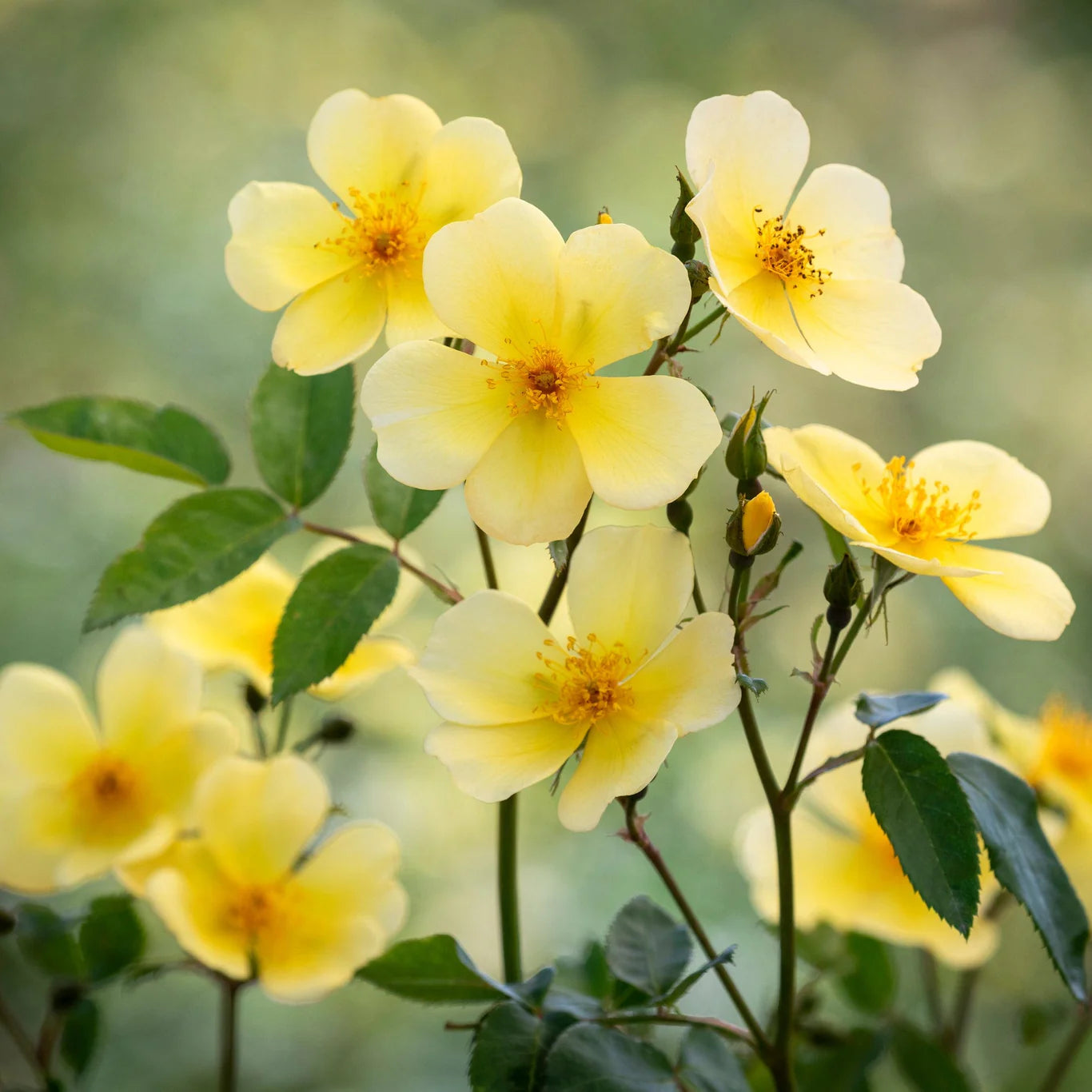
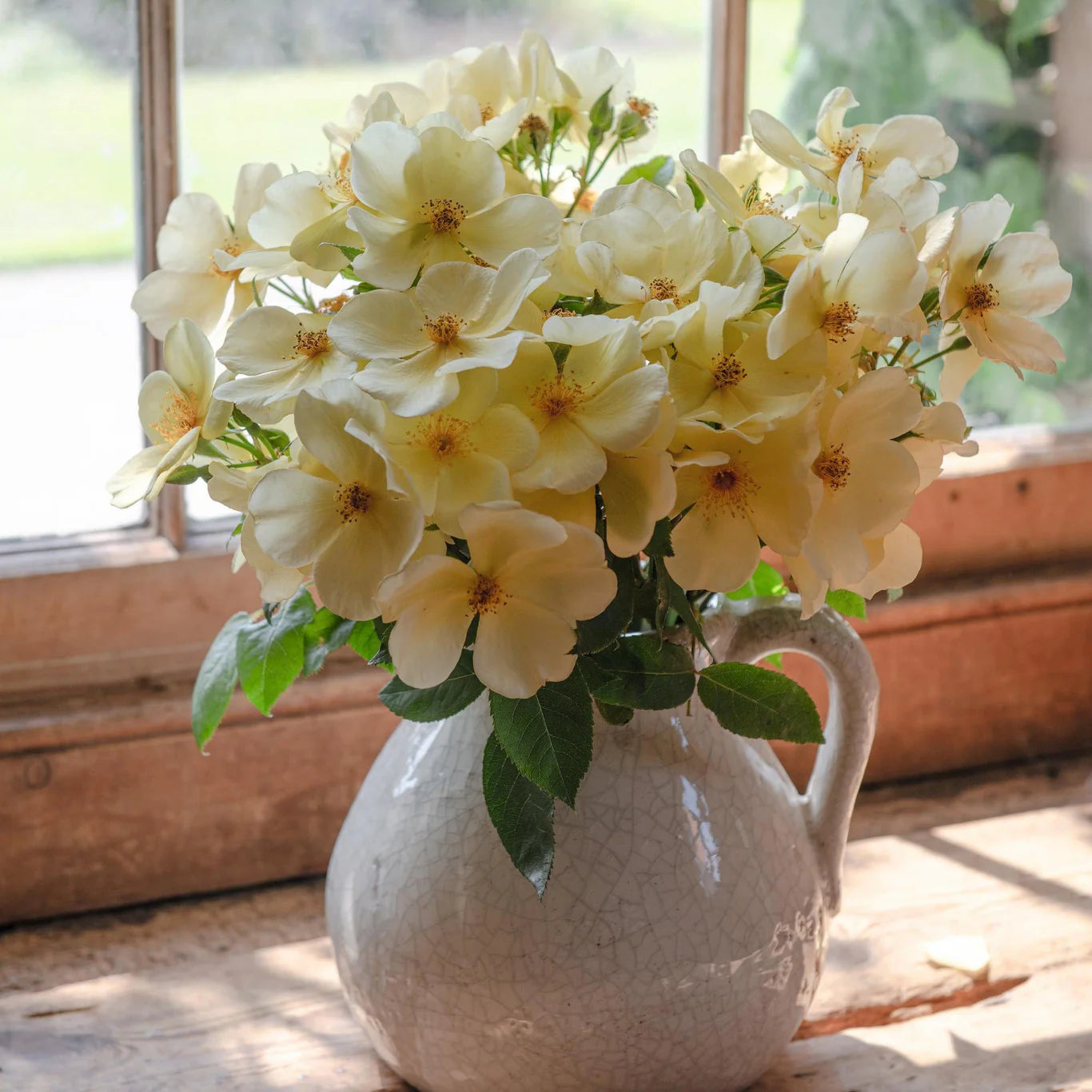
Its beauty is found in the simplicity of its single yellow flowers and the spectacular display they create when viewed en masse. They are held in large, open sprays on a rounded, branching shrub. Named to celebrate the 25th anniversary of Annie Tempest’s classic weekly cartoon.
Used for Rose Hips.
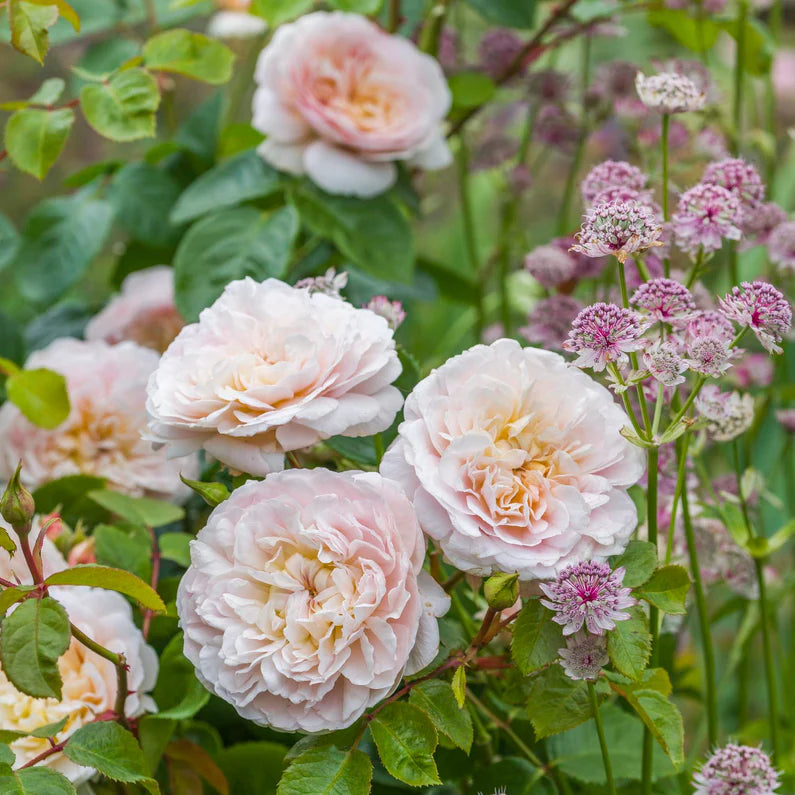
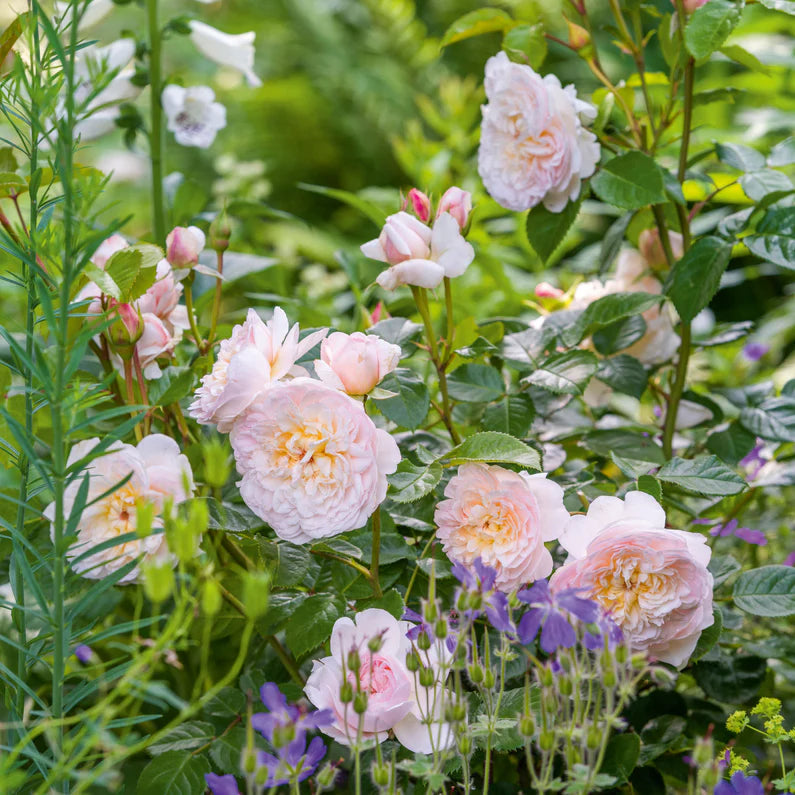
An exceptionally beautiful rose with distinctive neat, flat blooms. Each bloom is a lovely soft pink, the smaller central petals deepening to rich apricot and surrounding deep-set stamens. The strong Tea scent becomes more Old Rose, with delicious hints of lemon and grapefruit. It forms a bushy shrub with strong, healthy, upright growth. Named for the Brontë Society to celebrate the bicentenary of the novelist’s birth.
David Austin Roses were not developed for Zone 3. BUT it is possible to have success here in Manitoba by following a few key tips.
Choose a location that is not in line with strong north winds
Plant the crown (this is where the roots end and the woody shrub begins) of your rose 6”-12” below the surface of the soil. As your shrub will be in full leaf at time of purchase clean off leaves that will get buried.
In the fall you will need to cover with a deep layer of mulch. Wood mulch, straw, leaves or a combination of all. Use a burlap tarp (Not Plastic) to cover and hold down with rocks or stakes. This will ensure the mulch is not blown away. A full wheelbarrow or more per rose is not out of the question. Throughout the winter direct your snow clearing efforts to cover your roses as well. The more insulation the better.
Don’t remove the tarp and mulch until night temperatures are consistently hovering about zero to +3 with no threat of deep freeze, as we sometimes see in April.
We hope you enjoy growing your David Austin Rose.


Pink-tinged buds open to medium-sized cups held in large clusters. Pale yellow, paling to white at the edges; each has a rich yellow eye. The fragrance is similar to green tea with aspects of lemon and honey. It forms a bushy, upright shrub. Named for the artist, designer and founder member of the Bloomsbury Group – sister of the writer, Virginia Woolf.


Bears medium-sized neat rosette blooms – tinged with orange at first, quickly becoming rich yellow. It has a light-medium musky Tea Rose scent. The growth is compact, even and upright. Named after Wolverhampton Wanderers’ football stadium.


Soft orange-red buds open to medium-sized, cupped rosettes of perfect apricot coloring. They are extremely robust and have a lovely fruity Tea scent. Very healthy; it matures into an attractive, rounded, bushy shrub with few thorns. Named to mark the centenary of Roald Dahl’s birth, with the approval of his wife, Liccy Dahl – the colouring reminiscent of the eponymous peach in James and the Giant Peach.
David Austin Roses were not developed for Zone 3. BUT it is possible to have success here in Manitoba by following a few key tips.
_________________________________________________________________________
You have three options, you can enjoy your David Austin Rose for a single season. You can plan to bring your potted David Austin Rose into a warmer winter environment, or you can plant it into the ground.
If you decide to enjoy your rose for the summer:
Feel free to drop your potted David Austin Rose into a decor pot of your liking, but do not pot it up into a larger size planter. You do not want to set back your rose. We use our Rose and Perennial Mix when potting up all our David Austin Roses and other than fertilizing your rose every other week they are simple to care for. In our experience you should have blooms from late June right through till fall.
If you decide to grow and over winter your rose in a pot:
First, you must be sure you have a place to overwinter your David Austin Rose and you should pot up your rose into a planter large enough for min of 2 years growth, using our rose and perennial mix.
Do not use pro mix.
A heated garage or sunroom that can be set between -2C and -5C. You will also need to keep your rose away from doors that open to -35C or colder. Your Rose needs to go dormant for a few months. Once the temp is over zero C you will see your rose begin to send out new shoots. At this point natural light is necessary and the temperature should not go below -1C at night. It is important to keep your shrub moist but not wet. Check temperature regularly. Do not bring it into the house! Roses can handle cool nights and warmer days.
If you decide to plant your rose in the ground:
Choose a location that is not in line with strong north winds
Plant the crown (this is where the roots end and the woody shrub begins) of your rose 6”-12” below the surface of the soil. As your shrub will be in full leaf at time of purchase you can clean off leaves that will get buried if you like.
In the fall you will need to cover with a deep layer of mulch. Wood mulch, straw, leaves or a combination of all. Use a burlap tarp (Not Plastic) to cover and hold down with rocks or stakes. This will ensure the mulch is not blown away. A full wheelbarrow or more per rose is not out of the question. Throughout the winter direct your snow clearing efforts to cover your roses as well. The more insulation the better.
Don’t remove the tarp and mulch until night temperatures are consistently hovering about zero to +3 with no threat of deep freeze, as we sometimes see in April.
We hope you enjoy growing your David Austin Rose.


|
Bloom Size |
Medium |
|
Bloom Colour |
Creamy White |
|
Fragrance |
Strong Myrrh |
|
Year of Introduction |
2007 |
|
Size |
3m |
|
Family Climbing |
Root Own |
|
Flowering |
Repeat Bloomer |
|
Petal Count |
David Austin Roses were not developed for Zone 3. BUT it is possible to have success here in Manitoba by following a few key tips.
Choose a location that is not in line with strong north winds
Plant the crown (this is where the roots end and the woody shrub begins) of your rose 6”-12” below the surface of the soil. As your shrub will be in full leaf at time of purchase you can clean off leaves that will get buried if you like.
In the fall you will need to cover with a deep layer of mulch. Wood mulch, straw, leaves or a combination of all. Use a burlap tarp (Not Plastic) to cover and hold down with rocks or stakes. This will ensure the mulch is not blown away. A full wheelbarrow or more per rose is not out of the question. Throughout the winter direct your snow clearing efforts to cover your roses as well. The more insulation the better.
Don’t remove the tarp and mulch until night temperatures are consistently hovering about zero to +3 with no threat of deep freeze, as we sometimes see in April.
We hope you enjoy growing yourDavid Austin Rose.


Peachy pink buds open to beautiful, white, chalice-shaped blooms, with a pinkish hue. The incurved petals create an arresting interplay of light and shadow. The strong Old Rose fragrance has hints of almond blossom, cucumber and lemon zest. It forms a most attractive neat, rounded, bushy shrub. Named after the tragic heroine of Shakespeare’s Othello.


An exceedingly pretty rose of soft, glowing apricot-pink, each bloom packed with numerous delicately ruffled petals. Held on red-tinged stems, the blooms begin as shallow cups, opening to full rosettes, revealing petals of a richer hue, which gradually pale over time. They have a delicious strong fruity fragrance. A very healthy variety; itmakes a strong, vigorous shrub with bushy, upright growth. Named after the flawed heroine of Thomas Hardy’s, The Return of the Native.