
154 products
154 products
Sort by:
Gardener Gifts

Exposure Full-sun
Matures in 75 days

Exposure Full-sun
Matures in 45 day

Habanero pepper seeds are central to the cuisine of Yucatan, Mexico. The little lime-green peppers ripen first to sunset golden, and then to "You've been warned" red. Mature 5cm (2") habaneros have a citrusy flavour and aroma. The seed is slower to germinate (up to 3 weeks) and should be kept at 21-24°C (70-75°F). Use bottom heat of a Seedling Warmer heat mat to accelerate germination. Plants need fertile soil and lots of heat to mature but are well worth the time - and the tears. For most regions in Canada, providing protection to increase heat and lengthen the growing season is necessary for success. At 100,000 - 350,000 SHU's, these powerful chiles are for spice lovers, and not for the faint of heart. Can be grown in containers.
Matures in 100 days. (Open-pollinated seeds)

Oregon Giant snow pea seeds produce plants with unusually large, broad 13cm (5") long pods are thick and very sweet. They are most tender when peas begin to form but remain so up to the very largest sizes. Plants stay short at only 1.2m (4'). This variety is very resistant to pea enation virus and powdery mildew, which makes it a good candidate for late sowing and summer/fall harvest. Sow as late as July, and enjoy a second fall crop. Enation virus is a serious problem for peas in our region, so if you're planting peas after April first, choose enation-resistant varieties only. Winner of the RHS Award of Garden Merit.
Matures in 70 days. (Open-pollinated seeds)

Ipomoea tricolor. It is a great shame that so many gardeners confuse this tidy heirloom annual with the invasive bindweed, Convovulus arvensis. Both share the name Morning Glory, and both have trumpet shaped flowers, but the similarities end there. Heavenly Blue morning glory seeds produce short vines bearing copious, huge, intensely blue flowers that open each morning and then fade to pink before closing for good in the evening. Every day more flowers open from mid to late summer. It looks spectacular climbing along a fence or trellis, with really large flowers that can only be described as Heavenly Blue.
Note: This variety is not an invasive weed.
Annual

Tagetes patula. Red Cherry is an ornate, bi-coloured marigold. The yellow centres of these long-blooming flowers are framed by red petals that feature yellow edging. The foliage on the plants are full and grow 25cm (10") tall. Perfect for patio containers, beds and borders. Marigolds are great companion plants and act as a deterant for some pests.
Annual

Genovese organic basil seeds are the very best Italian pesto variety of basil. This is the traditional Italian heirloom variety of basil. It has shiny, large, almond-shaped leaves have a more pronounced flavour, and stores well if chopped and frozen in ice cube trays. Pinch growing tips for bushier plants that grow to 60cm (24") tall. Basil is a heat loving tender annual plant that requires good drainage and ample moisture during hot weather. If flowers develop, either save save the resulting seeds or separate them from the plants and sprinkle over pasta or salads. Basil flowers are highly attractive to honeybees and other wild pollinators.
Basil can be planted as a companion to tomato plants. It is said that basil improves the flavour of tomatoes.

Easter Egg II radish seeds are a blend of six distinctly coloured radishes. The flesh is white and the roots can become relatively large without getting pithy. Look for white, rose pink, bubblegum pink, amethyst, mauve, scarlet and purple roots. The uniform roots are round, crisp, and flavourful, with tops that are good for bunching. Get the most out of your radish bed with this blend of diverse colours for spring and fall growing. Provide some frost protection, and you may be able to grow for winter harvests. Once radishes begin to bolt in response to warm soil in early summer, they should be pulled and composted. The process cannot be reversed, and a bolting radish is no good for eating.
Matures in 28 days. (Open-pollinated seeds)

Raphanus sativus. Daikon radishes are large and require deeply prepared soil, as they can grow to over 30cm (12") long. One of the best daikon radishes for summer, Minowase Summer Cross have white roots that are 15-20 inches long and 2.5" in diameter. The pure white flesh is excellent for salads, sandwiches, cooking, and pickling. Flavour is milder when grown to maturity in fall, in light soil, and with good irrigation.
Sow and grow as you would turnips, thinning them to 15-20cm (6-8") apart. At each cultivation, push the soil over the top of the root.
Matures in 50 days. (Hybrid seeds)

Smooth-skinned, bright red radishes with a very round, uniform shape. Cherriette is bred to perform in higher temperatures, so it holds better potential for harvesting into summer. The ideal production time is spring and fall. The pure white flesh of Cherriette is dense and crisp, with a sweet, hot flavour. This is a very uniform radish variety that is slow to develop pith. Its tops are short, but sturdy for bunching. Cherriette has out performed the open pollinated varieties in our trials. Try Cherriette in window box type containers. Plant short rows every two weeks from March to early May, and again in September and October for fall harvests.
Matures in 24 days. (Hybrid seeds)

Helenor Organic rutabaga seeds are CERTIFIED ORGANIC! The colour develops early on these nice, uniform, round roots. The flesh is light orange and sweetly flavoured. Helenor is an excellent choice for fall and winter harvests.
Rutabagas are surprisingly versatile in the kitchen and are widely used around the northern hemisphere. They can be julienned and eaten raw as a side salad, or roasted, boiled, or grilled. Many recipes call for mashing rutabagas after cooking, and the classic Scottish dish neeps and tatties combines them with mashed potato. It is a useful winter source of vitamin C, and the roots will store for months.
These seeds are coated with an inert, organically certified layer which helps to minimize clumping in storage and seed sowing machines. The coating is approved by organic certifiers in Canada, the US, EU, and Japan.
Matures in 90 days. (Open-pollinated seeds)
- Stores for months
- Fall & winter harvests
- Extremely versatile
- Matures in 90 days
- Open pollinated seeds

The standard summer squash, introduced in the 1920s. Large bush plants grow semi-upright and open, and are loaded with glossy dark green fruits with firm creamy white flesh and fine flavour. Plants are productive very early, and over a long period. Best eaten when under 20cm (8" long). Black Beauty zucchini seeds are the best variety for freezing. Black Beauty zucchini is a 20th Century heirloom that won the All American Selections prize back in 1957. It was first introduced to American market growers in the 1920s, and was commercially available as seed from the 1930s on.
Matures in 60 days. (Open pollinated seeds)

Sweet Basil organic seeds are CERTIFIED ORGANIC! This vigorous basil variety produces large, mid-green leaves all summer long. Keep picking the growing tips and the 2 pairs of leaves below them for the kitchen. More branches will sprout producing more leaves. This large-leaved Italian type is the preferred variety for traditional pesto recipes. Plant several times for a continuous supply until frost. Grow some organic sweet basil in a pot on a warm and sunny windowsill, and harvest fresh leaves right through the winter. Basil is a heat-loving plant so wait until the soil has warmed up before planting. Basil seeds may take several weeks to germinate, so be patient. Bottom heat speeds germination.
- Large leaved, Italian type
- Grow one on a sunny windowsill
- Vigorous plants with mid-green leaves
- Plant several times for a continuous supply
- Pinch the growing tips for bushy growth
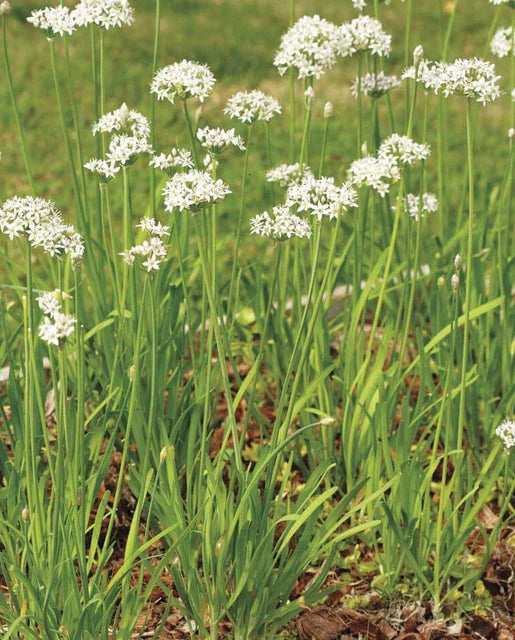
A. tuberosum. This flat-leaf variety of Garlic Chives seeds has a strong garlic flavour and aroma. The white flowers and stalks are used (only a small amount is needed), to add the pungent taste of garlic to salads, vegetables, dumplings, and stir-fries. Popular in Asian cuisine, garlic chives are also known as ku chai in Chinese. While the leaves and flower stems are delicious and useful in the kitchen garlic chives are also very attractive flowering plants. Use this herb as companion plants to repel aphids from flowers or vegetables prone to attack.
- Strong garlic flavour and aroma
- Powerful flavour
- Popular in Asian cuisine
- Flat-leaf variety
- Add to salads, dumplings and stir-fries

Coriandrum sativum. Cilantro "Santo" is bred to be slow bolting. Direct sow short rows of Santo Long Standing cilantro seeds every other week from spring to late summer for continuous harvest. The mature seeds, better known as coriander, are easy to harvest, and used in many dishes - notably curry powder blends. Keep an eye you your cilantro crop because the flowering process (bolting) is famously quick in this plant. As soon as a central stem appears and the uppermost leaves become frilly, it's time to harvest the whole plant, roots and all.
If growing for seeds, simply allow the plants to flower. Cilantro flowers are highly attractive to beneficial insects like Syrphid flies, lacewings, and lady beetles. Be warned that if the seeds are not harvested when they are mature, you will have volunteer cilantro plants for years to come.
Cilantro will grow somewhat leggy, but productively in partial shade, and it is quite tolerant of cool temperatures. With the protection of a cloche greenhouse, cilantro will continue growing all winter.
- Easy to grow
- Mature seeds are coriander
- With a bit of cover, it will overwinter
- Grows to 50cm (20")
- Grows in partial shade

Plant Forest Green parsley seeds in your organic herb garden. The plants have short, strong stems that support big clusters of highly curled, dark-green leaves. The flavour is distinctly savoury without being bitter. Parsley adds a subtle, but key flavour to a host of Mediterranean dishes. It is widely used in companion planting because its strong scent repels insects like the Asparagus Beetle. Parsley likes asparagus, carrots, chives, corn, onions, and tomatoes. The leaves can be sprinkled on asparagus to repel asparagus beetles, and around roses, to improve their scent. Let some of your parsley go to bloom to attract hover-flies and predatory wasps.
Parsley is a biennial plant that forms a long (edible) tap root. Choose deep pots for container growing.
Matures in 80 days. (Open-pollinated seeds)

Dwarf Grey Sugar snow pea seeds produce the earliest and most dwarf edible pods of all. The prolific, bushy vines grow to 1.5m (5') tall, and benefit from staking. Very attractive sweet pea-like flowers are followed by clusters of flat, fleshy, curved, semi-pointed pods. These are light green and average 6-8cm (2.5-3"), appearing at the tops of the plants for easy picking. This old heirloom variety was listed once as Dwarf Gray Sugar Cabbage Pea, and has been in production since before 1773. Dwarf Grey Sugar snow pea seeds were first sold commercially in 1892 by D.M Ferry and Company. This is one of the best choices for growing pea shoots and pea tips.
Matures in 66 days. (Open-pollinated seeds)

Pearl is the perfect name for this classy, refined, pure white radish. Pearl holds its round shape better than other white varieties, even in less-than-optimal conditions. Mild flavour with a hint of heat. Strong tops for easy harvest and bunching.
Matures in 28 days


Exposure Full-sun

Maintains dwarf mounding habit with height reaching between 4-6"
Exposure: Full Sun

Maintains dwarf mounding habit with height reaching between 4-6"
Exposure: Full Sun

These wonderful large beans mature in 75-85 days when sown in the spring, or 6 months if fall sown. The plants grow 90-120cm (3-4') tall. The light green pods, which contain 6-7 large pale green seeds each, shell easily. Windsor broad bean seeds are superb for family gardens and easy for small children to handle. Broad Windsor is intended for growing as a food crop. The seeds it produces are large and succulent, unlike the small-seeded fava we offer as a cover crop. This large variety will fix nitrogen in your soil, so it’s perfect for planting in the fall, harvesting in the spring, and following with nitrogen loving crops like Brassicas, lettuce, or spinach. Fresh or dried, broad beans must be cooked before eating in order to rid them of potentially toxic alkaloids. The young, tender leaves can be eaten raw, or cooked like spinach. Broad beans are one of the world’s most ancient and widespread food crops.
Matures in 75-85 days. (Open-pollinated seeds)

Tagetes erecta. These vigorous, very upright marigolds feature large, deeply orange flowers with highly ruffled petals. Kees' Orange marigold grows to 60-70cm (24-28") tall, and works well in containers or in the vegetable garden where it makes a generalist companion plant for pretty much all crops. It attracts beneficial insects and repels pests. It is great as a long-lasting cut flower, and looks amazing planted in large groups. Space them carefully to allow for good air circulation.
Annual

Mentha x piperata. Hot, rich mint aroma issues from the crushed or dried leaves of this spreading perennial plant. Consider growing Peppermint seeds in containers, as it will become hard to control over the years. Both the leaves and flowers can be dried for teas or use in stews and sauces. Peppermint grows well in moist soil in full sun to heavy shade. Mint flowers are edible, and highly attractive to bees and other pollinators. Mint plants spread by an ever-expanding rhizome that grows parallel with the soil. Along its length, new stems emerge with new leaves and flowers. This is why many gardeners prefer to grow mint in containers than in the open soil.

Red Iceberg lettuce forms a rosette of tasty, nutritious, and richly red outer leaves as it grows. Eventually a tightly-packed, pale green iceberg head forms at its centre, gilded with red markings on the outside. The interior is sweet and mild, with a very pleasant, crisp texture. The head holds well against the heat of summer with a delayed seed set. This was a standout in our seed trials and drew a lot of attention.
Matures in 50 days. (Open-pollinated seeds)

This winter-hardy heirloom is a distinctive black colour on the outside with a milky white and tender interior that packs a bit of bite. Large turnip-shaped 8-10cm (3-4") diameter globes with deep black skins over solid, crisp, pungent, pure-white flesh. Black Spanish Round radish seeds have very tall tops, and are primarily grown for winter storage. They will stay fresh all winter if stored wet sand. This variety was introduced before 1824, and is listed in some old seed catalogues as Noir Gros Rond d'Hiver. Plant Black Spanish Round radish seeds in mid to late summer and eat when it is the size of a quarter. Space radishes 8-10cm (3-4") apart.
Matures in 60 days. (Open-pollinated seeds)
- Tender and packs a bite
- Distinctive black skin
- Winter hardy heirloom
- Open-pollinated seeds
- Matures in 60 days
Sow seeds 5mm (¼”) deep, 25 seeds per 30cm (12″) in rows spaced 30-45cm (12-18″) apart, and thin to 6-12 plants per 30cm (12″).

A speedy new hybrid for baby-leaf spinach production or full-size growing. The flavour is simple, but pronounced, and excellent for raw salad eating. Yukon spinach seeds grow so fast that it's a good option for filling in between other main season crops. Try it for fall and early winter harvests under low tunnel protection. Yukon has high resistance to Downy Mildew races 1-12, 14, and 15, with intermediate resistance to race 13. Spinach does best in cool weather. Direct sow March 1 to April 15. For late spring and early summer plantings use Tyee, and for quick harvest use Space and Olympia. Spinach will bolt once days get long and hot. Some varieties grow enough to harvest before they bolt. For continuous supply, plant every 3 weeks.
Matures in 38 days. (Hybrid seeds)
- Super fast growth
- High resistance to downy mildew
- Great for low tunnel production
- Matures in 38 days
- Hybrid seeds

This great tasting heirloom spinach has thick, succulent, dark-green savoyed or crumpled leaves that are very sweet in salads or cooked. Bloomsdale Savoy is best planted in early spring and fall. If Bloomsdale Savoy spinach seeds are fall-planted, it will overwinter and produce much earlier than if it is spring-planted. Very fast growing plants with upright growth that can be mechanically harvested when necessary. This spinach has high resistance to blight and blue mold (BM). We recommend sowing spinach seeds in the third week in August on the coast. Enjoy a fall harvest, but only cut the leaves from the ground level. The following spring, you will get a huge harvest of incredibly early, tasty spinach before there are any pests around to compete with.
Matures in 50 days. (Open-pollinated seeds)
- Very sweet in salads or cooked
- Thick, succulent leaves
- Can be overwintered
- Open-pollinated seeds
- Matures in 50 days
Sow seeds 1cm (1/2″) deep, 10 seeds per 30cm (12″), in rows 30-45cm (12-18″) apart. Thin to at least 5-8cm (2-3″) between plants, or further if you want larger leaves.
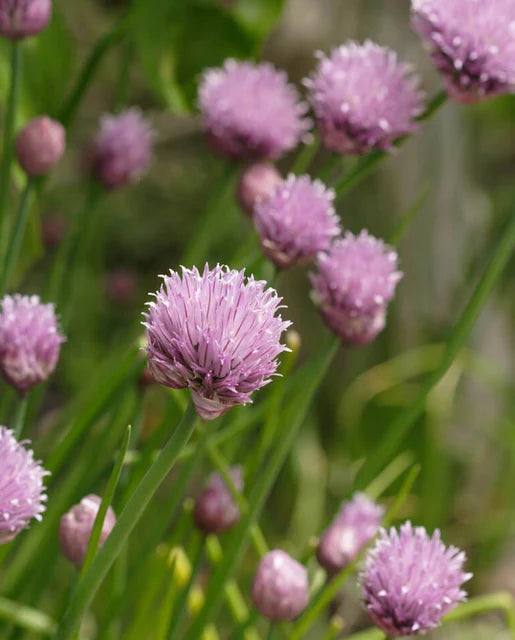
Sow chive seeds at any time of year. Hardy, perennial, and easy to grow, the chopped stems and pink flowers add a fresh, mild green onion flavour to sandwiches, salads and baked potatoes. Clumps can be divided in spring or fall. If grown in containers, divide frequently enough to provide for constant lateral growth. Chives are surprisingly hardy and can be harvested all winter if given some protection from extreme cold. They are also quite drought tolerant, so they're good candidates for xeriscaping. The edible flowers are highly attractive to bumblebees, hoverflies, and other beneficial garden insects.
- Fresh, mild, green onion flavour
- Hardy and easy to grow
- Use stems and pink flowers
- Used dried flower stems in arrangements
- Excellent choice for the container herb garden
Sow 5mm-1cm (¼-½”) deep and keep moist until germination. If starting indoors, use bottom heat and plant 10-15 seeds per cell in a 72 cell plug tray. Transplant either into containers or into the garden once the soil has warmed up. Space clumps 15cm (6″) apart.